


[DIGEST: Discover Magazine, Futurism, HyperPhysics, Merriam Webster, Colblindor, ScienceDirect, Colour Blind Awareness, Popular Science, New York Magazine]
Most humans can see around one million distinguishable shades, or hues, of color. That is because we have three types of photoreceptor cells, called “cones,” in the retinas of our eyes that allow us to perceive color. These three color-sensitive cones are the reason we can perceive blue, green and red hues. Thus, we are known as trichromats.
Now there is at least one woman alive today who sees not one million, but one hundred million nuances of color.
The colors of light exist on a wavelength spectrum. We perceive blues when the S-Cones in our retinas react to short wavelength light, greens when the M-Cones react to medium wavelength light, and reds when the L-Cones react to long wavelength light. Those who are colorblind are usually anomalous trichromats. They have all three types of cones but one of the types does not fully function or has a color sensitive weakness (also known as a mutated cone), resulting in a smaller color spectrum. Less common are dichromats, who have only two types of cones in their retinas, and monochromats, who have either one or none.
| Blue Colors | Short Wavelength Light | S-Cone Photoreceptors | |
| Green Colors | Medium Wavelength Light | M-Cones Photoreceptors | |
| Red Colors | Long Wavelength Light | L-Cones Photoreceptors |
The Invisible Color World of Tetrachromats
A paper on colorblindness published in 1948 by Dutch scientist HL de Vries suggested that there may be tetrachromats among us – those possessing a fourth active photoreceptive cone. The fourth cone was discovered by de Vries in the mothers and daughters of colorblind men, and in the 1980s Cambridge University neuroscientist John Mollon estimated that 12 percent of the female population could possibly be tetrachromats.
Color blindness is a genetic trait that manifests as a mutated cone, and it is far more commonly found in men than in women because it is carried on the X chromosome. Men only need the trait on their one X chromosome in their XY sex chromosome pairing, while women need it on both of their XX sex chromosome pairing in order to experience color blindness. Because of this, women in families that have a history of color blindness can still be genetic carriers even if they are not color blind themselves, and it is the same reason scientists assume that the fourth cone only appears in these women.
While colorblind men have only two normal cones and one mutated cone that is less sensitive to one of the three group-lengths of wavelength light (blue-short, green-medium, red-long), women in their genetic families possess all three normal cones as well as the mutant cone, for a total of four cones in their retinas.
However, these women are still not true tetrachromats, since they perceive the same number of colors as ordinary humans, suggesting that only three of the four cones are fully active in their retinas. But if ever all four cones were to be active and fully functioning, then that woman would be able to see 99 million more variations of color otherwise invisible to the naked eye. In other words, she would be able to distinguish hundreds of shades between the colors that we can see.
Mollon and others searched for further evidence of the elusive tetrachromat, but the search came up empty for another 20 years. Then in 2007, Dr. Gabriele Jordan, a neuroscientist at Newcastle University, as well as Mollon’s former student and research colleague, began a new testing method.
Previously, they had used a variation of de Vries’s test which required participants to mix red and green light to match a set shade of yellow, with the researchers’ expectations that they would never be able to make a match. But the women tested were able to make consistent matches. Jordan’s new test instead asked the women to look at three colored circle flashes at a time, and then choose which one did not match. Only a true tetrachromat would be able to distinguish the difference.
A few years later in 2010, Jordan finally found a true tetrachromat: a doctor living in northern England identified in Jordan’s research as subject cDa29.
Unfortunately, in the same way that it would be difficult to describe the difference between the colors red and green to a person who is red-green colorblind, we may never fully understand cDa29’s extraordinary power of sight. She has been unable to describe what she sees and how it is different from what we see, because she doesn’t know nor has experienced what we ordinary tetrachromats see. It might be something akin to two samples of blue that would seem the same to us, but appear to her as different as sky blue and navy blue, or looking at the world as if everything is an impressionistic painting.
Jordan continues to search for other tetrachromats before publishing her findings, at which time perhaps she will be able to shed more light on cDa29’s visual world. But for now there still is at least one other question on Jordan’s mind: “We know tetrachromacy exists. But we don’t know what allows someone to become functionally tetrachromatic, when most four-coned women aren’t.”
A Mosaic of Colors
Clues to Jordan’s question might be found in Concetta Antico, an Australian artist who researchers confirmed to be another tetrachromat in 2012. She sees “colors within colors;” an extraordinary world in a “mosaic of colors.”
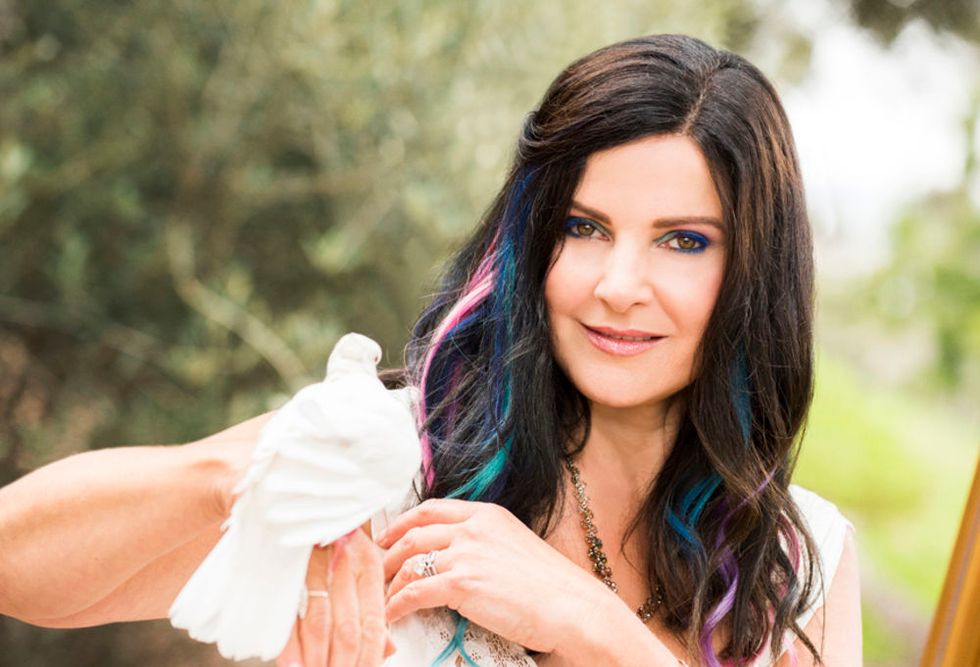 Credit: Source
Cognitive scientists Kimberly Jameson (Institute for Mathematical Behavioral Sciences at the University of California in Irvine) and psychologist Alissa Winkler (University of Nevada in Reno) have found that Antico’s fourth cone absorbs “reddish-orangey-yellow” wavelengths, but they are still uncertain how they actually appear to her.
Her art though might give some insight. When looking at a leaf, she claims to see a rainbow in a simple shade of green: “Around the edge I’ll see orange or red or purple in the shadow; you might see dark green but I’ll see violet, turquoise, blue.”
 Credit: Source
As an artist, Antico is more equipped to describe what she sees, but even then she is restricted to the words of colors that we are already familiar with. Nevertheless, she uses her art to show us the world as she sees it, and her tetrachromatic vision comes in handy in other, less-expected ways, she says.
“I can tell if someone is sick just by looking at them. Their skin gets gray, it gets yellow, and there’s some green.”
For her, it is not always mesmerizing rainbows and visual delights, as her super color vision brings with it a heightened sensitivity. She is particular about the color coordination of her home and her family’s clothes, and she has to surround herself with soft, soothing colors. She sometimes finds the colors of rooms uncomfortable and suffocating, grocery stores and malls are overwhelming, and yellow stresses her out. The blood in horror films visually disturbs her, and she often is distracted by colors while in the middle of conversations with friends.
University of Washington vision researcher Jay Neitz proposes that more tetrachromats have not been awakened simply because there never is a need for an extra fourth cone in a world where everything and every color is manufactured for trichromats. Antico believes she is the exception because her fascination with color had her painting at an early age, exposing her to “exceptional color, so her brain became wired to take advantage of her tetrachromacy.”
Neitz suggests that others like cDa29 and Antico might need practice in a lab setting to activate their abilities. If he and other scientists can unlock the vision powers of tetrachromats, we could discover a new universe of hidden color sensation.
For further information: Discover Magazine, Popular Science, New York Magazine, Human Potential for Tetrachromacy





 Fox News






 @lovea.ham/Instagram
 @codyjcharrier/Instagram
 @mayhemhms/Instagram
 @joedlc71/Instagram
 @dubravkatambur/Instagram
 @lmcg1025/Instagram
 @summernova11/Instagram
 @heckincool_/Instagram
 @marleneclegg1/Instagram
 @ironlinedesigns/Instagram
 @jaywwalker/Instagram
 melissagilbertofficial/Instagram
 melissagilbertofficial/Instagram
 melissagilbertofficial/Instagram
 melissagilbertofficial/Instagram
 melissagilbertofficial/Instagram
 melissagilbertofficial/Instagram
 melissagilbertofficial/Instagram
 melissagilbertofficial/Instagram
 melissagilbertofficial/Instagram
 melissagilbertofficial/Instagram
 @_stillwerise/Instagram
 @aliceritter/Instagram
 @particulieres.nyc/Instagram
 @danielapakzad/Instagram
 @ariadnerosalesv/Instagram
 @blanksjewelry/Instagram
 @ginarockenwagner/Instagram
 @4everheber/Instagram
 @rachel.white.nyc/Instagram