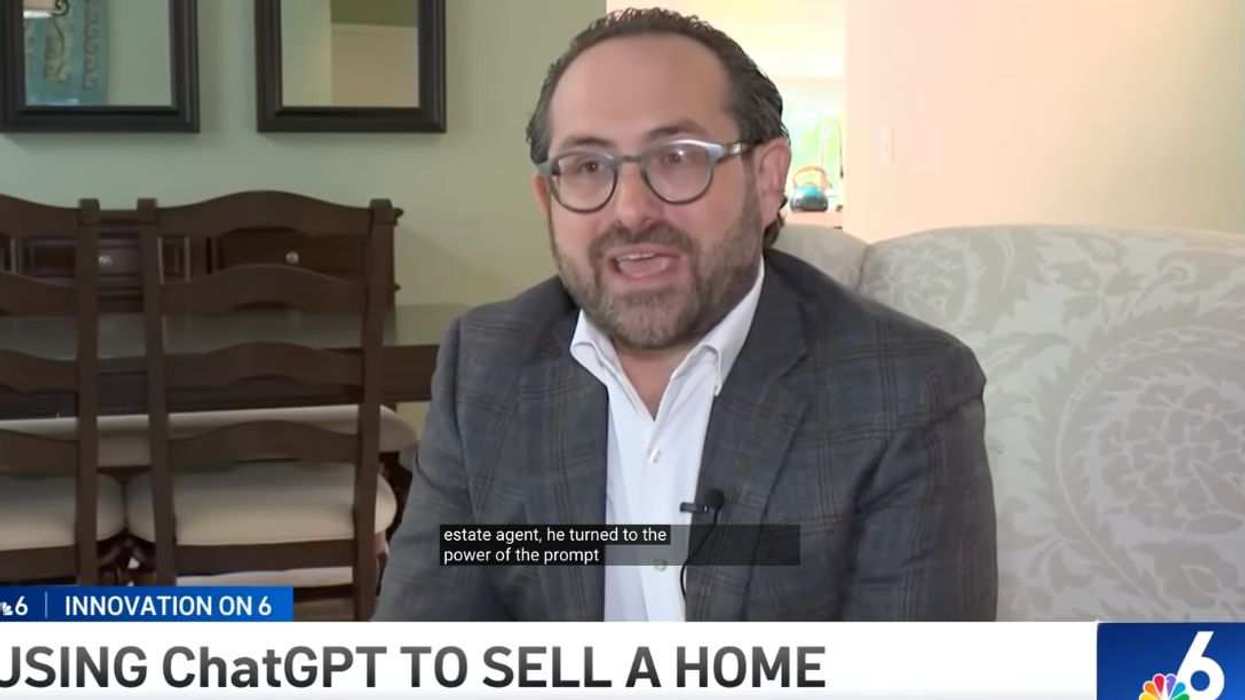

A Florida man decided to trust ChatGPT with something most people wouldn’t hand over lightly: pricing, listing, negotiations, even the legal paperwork. Just five days later, he had a nearly $1 million sale on the books, landing about $100,000 higher than what real estate agents told him was realistic.
Robert Levine claimed that ChatGPT walked him through planning, pricing, and marketing:
“I really wanted to challenge myself to use AI for the entire journey, not just piecemeal, every step along the way.”
The South Florida father of three said the AI tool helped guide everything from early packing to pre-sale improvements, including which rooms to repaint for maximum return and when to list the home on the Multiple Listing Service.
Levine detailed ChatGPT’s role in prepping the home:
“We repainted a couple of rooms in the house because ChatGPT said that's where you're going to get the biggest return on investment. The most important thing it did for us was build out a timeline. Here's when you need to start packing your house.”
Within 72 hours, Levine said he had five offers. The home ultimately sold for $954,800 just five days after hitting the market. And the contract? Also generated with the help of ChatGPT.
There’s no question Levine views the experiment as a success. He avoided paying a traditional real estate commission and told Fortune the home sold for roughly $100,000 more than agents had suggested.
But there’s an important caveat that tends to get buried in the headline-friendly version of this story: Levine still hired a lawyer to review the contract and related legal documents.
Levine addressed the financial upside:
“We estimate that leveraging these AI tools will save us about 3% of the total sale price, which in our case is a meaningful amount of money.”
He also made it clear that AI isn’t replacing real estate agents outright—at least not yet—framing it instead as part of a broader shift in how people approach complex transactions.
Levine, on AI’s growing role:
“The impact they make is very real. And some folks maybe aren't prepared to do that themselves, but the more you use AI, the more confident you'll become in leveraging those tools.”
You can view the interview with NBC 6 South Florida here:
- YouTubeNBC 6 South Florida
For all its perceived utility, ChatGPT still couldn’t handle everything. Levine noted that while the tool helped him choose a moving company, it stopped short of actually packing boxes.
Still, not everyone is buying the narrative at face value as the internet debated the story’s bigger implications, questioning how much of the success was actually driven by AI versus Levine’s own expertise and resources.
You can view the reactions below:
A closer look at what ChatGPT actually did in this case suggests something less revolutionary than the headlines imply. Much of the guidance—pricing research, listing strategy, basic timelines—mirrors information that’s already widely accessible through standard online searches, albeit packaged more conveniently.
Then there’s Levine himself. Beyond being a homeowner, he’s also the CEO of ComOps, a consulting firm focused on operations, customer experience, and digital strategy, context that adds another layer to how this story is being received, particularly given the company’s use of AI-driven tools.
Levine leaned into that angle in a recent LinkedIn post:
"I didn't do this for publicity—I did it to challenge myself. At ComOps, we spend a lot of time helping clients turn insights into action using AI."
The legal piece, in particular, has drawn scrutiny. While ChatGPT may have helped draft documents, the involvement of a human lawyer undercuts the idea that the process was fully automated or risk-free.
Even some of the more widely praised elements, like building a timeline, fall into a category that skeptics argue doesn’t require advanced AI so much as structured planning. And driving much of the conversation is that tension between what’s genuinely new and what’s simply more efficient packaging.
Levine’s sale may point to how AI can streamline parts of a traditionally complex process, but it also highlights the boundaries: expertise still matters, professional oversight remains essential, and not every headline-worthy result is easily replicated.





 Brendan Smialowski/AFP via Getty Images
 Brendan Smialowski/AFP via Getty Images
 Brendan Smialowski/AFP via Getty Images





 @hannahhrevels/TikTok
 @hannahhrevels/TikTok
 @hannahhrevels/TikTok
 @hannahhrevels/TikTok
 @hannahhrevels/TikTok
 @hannahhrevels/TikTok
 @hannahhrevels/TikTok
 @hannahhrevels/TikTok
 @hannahhrevels/TikTok
 @hannahhrevels/TikTok
 @hannahhrevels/TikTok
 @hannahhrevels/TikTok
 @Raye455/X
 @JoJoFromJerz/X
 @phlynnmartin/TikTok
 @phlynnmartin/TikTok
 @phlynnmartin/TikTok
 @phlynnmartin/TikTok
 @phlynnmartin/TikTok
 @phlynnmartin/TikTok
 @phlynnmartin/TikTok
 @phlynnmartin/TikTok
 @phlynnmartin/TikTok
 @phlynnmartin/TikTok
 @phlynnmartin/TikTok
 @sailors.mama/TikTok
 @sailors.mama/TikTok
 @sailors.mama/TikTok
 @sailors.mama/TikTok
 @sailors.mama/TikTok
 @sailors.mama/TikTok
 @sailors.mama/TikTok
 @sailors.mama/TikTok
 @sailors.mama/TikTok
 @sailors.mama/TikTok
 @sailors.mama/TikTok
 @sailors.mama/TikTok