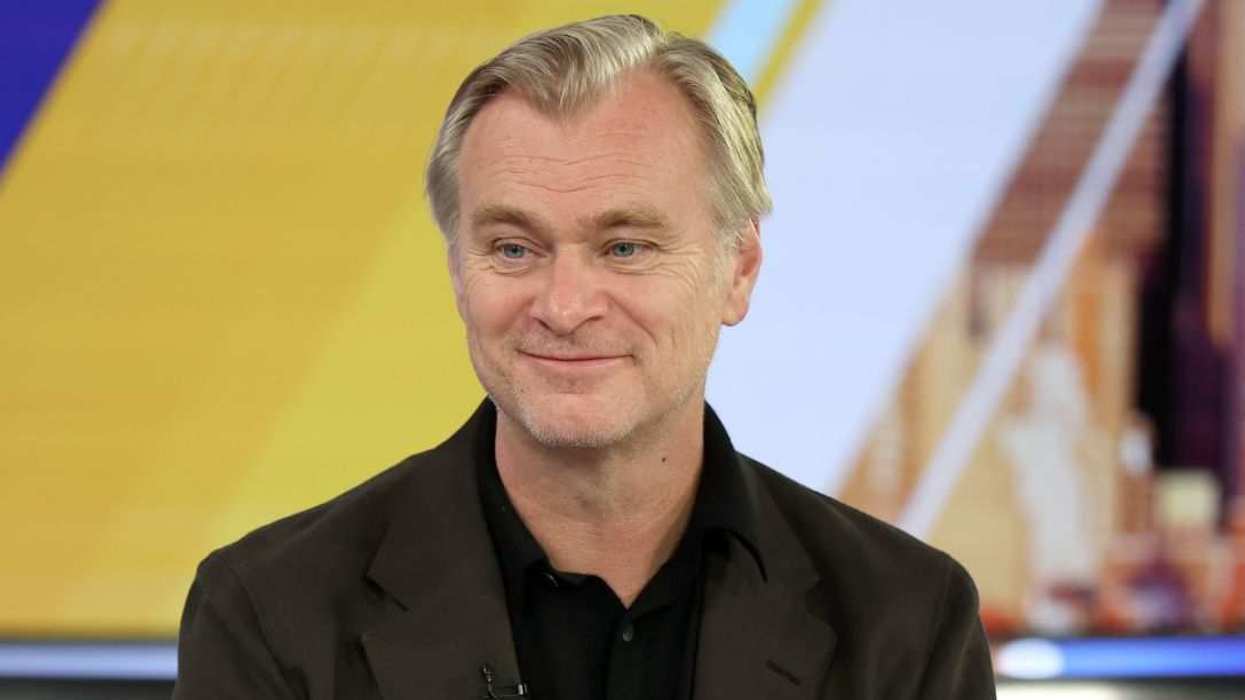

Christopher Nolan may have won over moviegoers with The Odyssey, but one of the scholars most closely associated with Homer's epic isn't nearly as impressed.
After just 12 days in theaters, the filmmaker's $250 million epic has grossed more than $727.9 million worldwide, cementing its status as one of the year's biggest box-office successes. The film has also earned strong reviews from critics, with many praising Nolan's ambitious take on the ancient Greek poem.
The Guardian film critic Peter Bradshaw praised Nolan's ambitious epic:
“Christopher Nolan’s Odyssey is a colossal origin-myth story of postwar disillusion and a loss of innocence.”
Bradshaw wasn't alone in his enthusiasm. Early reactions across social media were similarly positive, with several critics hailing Nolan's latest blockbuster as one of the year's standout theatrical experiences.
Time Out film critic Phil de Semlyen posted:
That praise, however, wasn't shared by Emily Wilson, the University of Pennsylvania professor of classical studies whose translation of The Odyssey Nolan cited as an inspiration for the film.
Wilson became the first woman to publish an English-language translation of Homer's epic—a milestone that also made her the target of misogynistic online abuse. In a lengthy review for the London Review of Books, she offered a far less enthusiastic assessment of Nolan's adaptation.
She argued Nolan's admiration for Homer didn't translate into compelling storytelling:
"I had hoped that Nolan’s affinity with these Homeric themes might push him to new creative heights and enable him to conjure more believable characters. But The Odyssey features his usual combination of grandiosity and superficiality.”
Wilson's criticism stretched well beyond the screenplay. She took issue with everything from the film's handling of its race-neutral casting, arguing many non-white characters primarily exist to support the white protagonist, to what she described as the "poorly designed" Trojan Horse.
In her view, the casting itself wasn't the problem—it was that many of those characters were left underwritten and served little purpose beyond advancing Odysseus' story.
Wilson pointed to Charlize Theron's portrayal of Calypso as one of the clearest examples of that criticism:
"Charlize Theron’s Calypso looks gorgeous, but she is never angry, never funny, not skilled in rhetoric, and never consumed by lust for her scraggly mortal victim. She’s an unpaid therapist, soothing the soul of the bedraggled, PTSD-ridden Odysseus with drugs, and graciously listening to his disjointed tale of woe."
In Homer's poem, Wilson noted, Calypso is a far more layered figure, delivering an impassioned speech about the double standards imposed on female gods while displaying wit, anger, and desire. She argued Nolan's version strips away those qualities in favor of a far more subdued character.
She reserved her sharpest criticism for the screenplay:
"Its narrative structure is gimmicky. The writing is abysmal. None of the characters has convincing motivation for their actions or words. There are no sex scenes, and all the food looks horrible."
Wilson ultimately concluded that Nolan's adaptation loses much of what has made Homer's epic resonate for centuries. As of publication, the Oscar-winning filmmaker has not publicly responded to her critique as he continues promoting the summer blockbuster.
But here's how the conversation unfolded online:
 u/MudBlood4Lyfe/Reddit
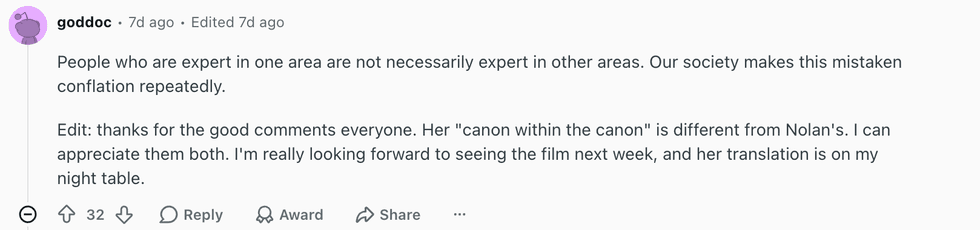 u/goddoc/Reddit
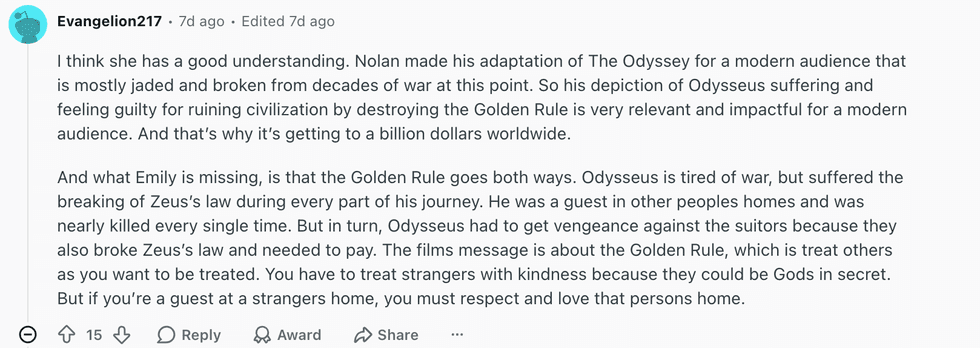 u/Evangelion217/Reddit
 u/senator_corleone3/Reddit
 u/hasanahmad/Reddit
 u/LRonPaul2012/Reddit
While Wilson's review drew attention for its blistering critique, she doesn't believe audiences should skip the film altogether.
Speaking with NPR, Wilson explained why she still recommends seeing The Odyssey:
"[W]hat is this film saying about … war, violence, and deception in our times, and also what it's doing with the source material. The actors are amazing. It's a star-studded cast, and they're doing their absolute best with the script they were given."
Even after taking Nolan to task, Wilson remains deeply invested in bringing ancient literature to modern audiences.
Her upcoming essay collection, Crossing the Wine-Dark Sea: Journeys Through Ancient Literature, arrives in September and explores Greek and Roman literature, the art of translation, and unexpected connections between classical texts and modern culture—including parallels between Cardi B and Megan Thee Stallion's music and the comedies of Aristophanes.
And she's not done with Odysseus yet. Wilson told NPR she's already at work on another translation of The Odyssey—this time freeing herself from the line-for-line constraints she followed in her acclaimed 2017 edition.