
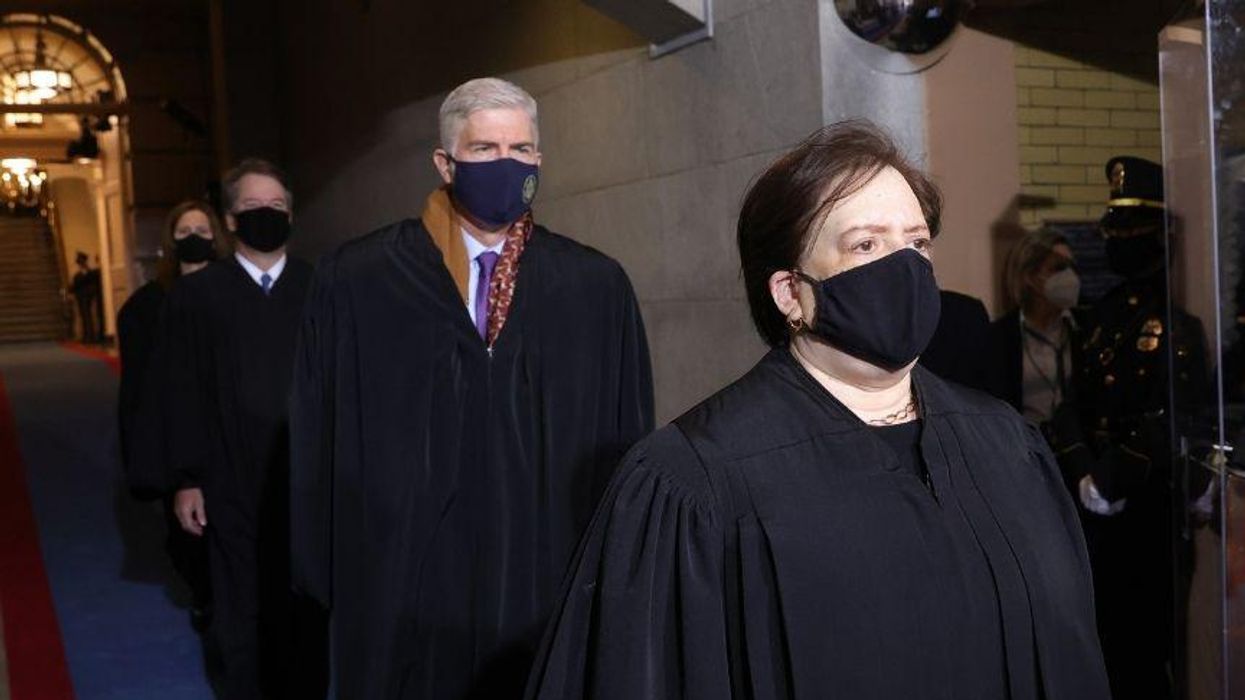

Conservatives howled when, earlier this week, Democrats—led by House Judiciary Committee chair Jerry Nadler (D-NY)—announced a bill that would increase the size of the Supreme Court to 13 justices from the current nine.
"This bill marks a new era where Democrats finally stop conceding the Supreme Court to Republicans," said Brian Fallon to NBC News. Fallon is a former Senate Democratic leadership aide and a co-founder of Demand Justice, who describes the Court as "broken and in need of reform."
This follows news earlier this week that President Biden is establishing a commission to study Supreme Court reform, a move that greatly displeased minority leader Mitch McConnell (R-KY):
"President Biden campaigned on a promise of lowering the temperature and uniting a divided nation. If he really meant it, he would stop giving oxygen to a dangerous, antiquated idea and stand up to the partisans hawking it."
Republican protestations are not quite as loud as those heard from the Democrats when McConnell refused for 293 days to hold a hearing for Judge Merrick Garland's Supreme Court nomination, on grounds it was too close to an election, only to turn around and ram through Amy Coney Barrett's nomination during the waning days of Trump's first term and in the middle of an election.
Turnabout doesn't seem fair or playful, however, to the GOP. "Democrats will do anything for power," Senator Tom Cotton (R-AK) tweeted in response to the bill's announcement, irony be damned. "Packing the Supreme Court would destroy the Supreme Court."
There is at least one thing that both sides likely can agree on: The process of appointing Supreme Court justices has become more political than ever, at least since FDR threatened to pack the Court during the New Deal after it blocked his agenda. While the bill to expand the Court in 2021 would never get past a GOP filibuster, it isn't clear that the Democrats would even have the votes to garner a majority on it anyway. But the political symbolism of Court expansion is strong, and it is likely to move both the parties' bases to action.
During the campaign, Republicans raised the specter of "court packing" to rally their voters, but then-candidate Biden demurred, saying he was in favor of establishing a commission to study the question. Biden fulfilled that pledge this week, setting up a body comprising 36 scholars, attorneys and historians. According to the New York Times, the commission will meet for 180 days and is charged with examining the Court's history, past changes to the process of nominating its justices, the process of selecting, hearing and adjudicating cases, and the range of consequences to altering its size.
However, the commission, at the request of President Biden, is not charged with issuing any specific recommendations. Rather, it will release what amounts to a research paper—likely to be cited as a definitive source in any future debates—that explores each of these questions from a scholarly, academic perspective.
There are a few baseline facts, however, for which a commission's report isn't needed.
First, there's nothing in the Constitution that sets the number of justices. That is done by statute, and the number has varied from as low as five to as high as ten justices in the past. It has been nine for a very long time, however, so any changes to that number would feel like a historic shift.
Second, there is little question that the Supreme Court does not currently reflect the popular will of the American people, with five out of six of the conservative justices nominated by presidents who did not win the popular vote.
Further, the Senate itself, which is charged with confirming appointments, is not a fully democratic body but rather part of a federal system that rewards rural states with greater representation. After Mitch McConnell removed the filibuster as applied to Supreme Court nominees, Democrats in the minority were unable to stop controversial appointees from moving forward, as we saw with the confirmation of Justice Brett Kavanaugh. There is of course the argument that the conservative makeup of the Supreme Court is a feature and not a bug of the system, depending on your political perspective.
Third, there are no set rules for when the Senate must or must not act to confirm a nominee, nor for when a nominee should or should not be put forward. The norms of this were stretched to an extreme with the recent appointments by former President Trump, the first of which was delayed long enough for him to take office and the last of which was pushed through just before he left.
Finally, there's nothing in Article III of the Constitution that mandates Supreme Court justices serve for life. It only states that federal judges shall hold their offices during "good behaviour." This could mean, for example, that a justice might sit on the Supreme Court for no more than 18 years but then continue to be a senior judge elsewhere for the remainder of her or his life. (Both Justice Sandra Day O'Connor and Justice David Souter retired from SCOTUS but served as judges thereafter.) Term limits on SCOTUS justices are actually heavily favored by the public, with most polls putting support at over three-quarters of respondents.
Biden's Commission does kick the can down his term for 180 days, which still leaves time for the Supreme Court to become a hot political issue for the 2022 election, particularly if Justice Breyer (who has come out strongly against court expansion) retires while the Democrats still control the White House and the Senate. Tellingly, House leadership threw more cold water on the court expansion bill as soon as it was announced. Speaker Nancy Pelosi stated she had "no plans" to bring the bill to a vote in the House, even while noting it was "not out of the question."
Indeed, Pelosi seems keen not to get ahead of the White House and its newly established commission, signaling stronger interest in other priorities.
Pelosi stated:
"I support the president's commission to study such a proposal, but frankly I'm not — right now, we're back, our members, our committees are working. We're putting together the infrastructure bill and the rest."
One final observation: In 2022, should Democrats pick up two more Senate seats (a result not out of the question given multiple retirements by sitting GOP senators) there may be sufficient votes to push through things like court expansion and term limits by eliminating the filibuster on bills addressing electoral or judicial reform.
To that end, the commission's report could serve as leverage to pressure moderate Democratic senators to get on board.




 @georgiamaythornley/TikTok
 @georgiamaythornley/TikTok
 @georgiamaythornley/TikTok
 @georgiamaythornley/TikTok
 @georgiamaythornley/TikTok
 @georgiamaythornley/TikTok
 @georgiamaythornley/TikTok
 @georgiamaythornley/TikTok
 @georgiamaythornley/TikTok
 @georgiamaythornley/TikTok







 @bsquaredtravels_/Instagram
 @bsquaredtravels_/Instagram
 @bsquaredtravels_/Instagram
 @bsquaredtravels_/Instagram
 @bsquaredtravels_/Instagram
 @bsquaredtravels_/Instagram
 @bsquaredtravels_/Instagram
 @bsquaredtravels_/Instagram
 @bsquaredtravels_/Instagram
 @bsquaredtravels_/Instagram
 @maddie_bado/TikTok
 @maddie_bado/TikTok
 @maddie_bado/TikTok
 @maddie_bado/TikTok
 @maddie_bado/TikTok
 @maddie_bado/TikTok
 @maddie_bado/TikTok
 @maddie_bado/TikTok
 @maddie_bado/TikTok
 @maddie_bado/TikTok