
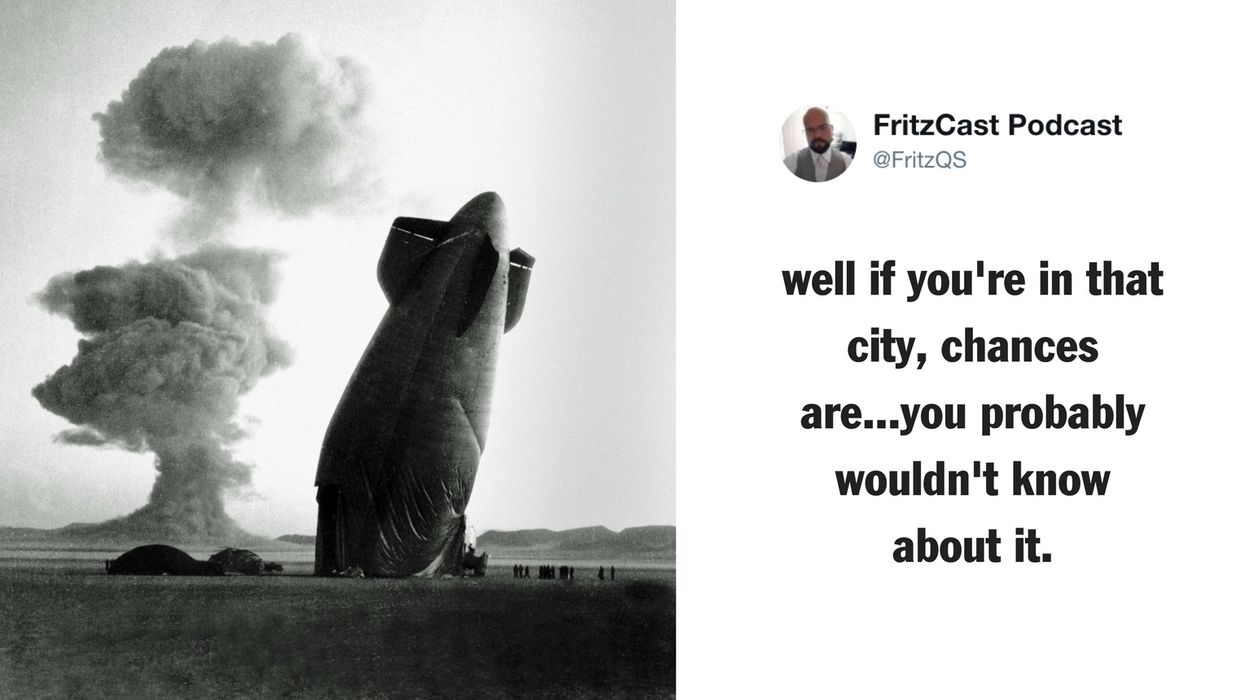

The threat of a nuclear disaster is looming and it doesn't help that the president just antagonized Vladimir Putin over Syria's recent chemical attacks.
Thanks to a new interactive map, we won't have to imagine the consequences of a potential nuclear attack. We can see a simulation of one and still come out of it alive.
How many people would die? What would remain after an explosion? You can find out the magnitude of destruction from a nuclear attack thanks to an interactive map that allows you to drop a bomb anywhere in the world for a horrific but fascinating simulation.
To help us visualize the impact of a nuclear blast in any designated place in the world, Alex Wellerstein – a historian of science at Stevens Institute of Technology – developed the interactive browser called the "NUKEMAP."
The historian of nuclear weapons created the first iteration of the browser in 2012 as he was writing a book about "the history of nuclear secrecy in the United States from the Manhattan Project through the War on Terror."
We live in a world where nuclear weapons issues are on the front pages of our newspapers on a regular basis, yet most people still have a very bad sense of what an exploding nuclear weapon can actually do.
In July 2013, Wellerstein upgraded the browser to "NUKEMAP2" enabling faster calculations based on fireball size, radiation zones, and air blast radius and renders visual results on Google Maps.
The system can operate specific functions allowing users to see a drifting cloud of radioactive fallout depending on weather conditions based on the geographic location.
Wellerstein, who insists is a "historian of physics, not a physicist," explained to Business Insider how he wanted to demonstrate the effects of a nuclear blast through "NUKEMAP."
A realistic understanding of what nuclear weapons can and can't do is necessary for any discussion that involves them," Wellerstein told Business Insider in an email. "People tend to have either wildly exaggerated views of the weapons, or wildly under-appreciate their power, if they have thoughts about them at all. It can lead to hysterical policies of all sorts.
The map allows users to create a hypothetical nuclear bomb by choosing preset options of historical detonations, including the B-83 – The largest bomb in the current U.S. arsenal, "Little Bomb" – The bomb used in Hiroshima, and the R-12 (SS-4) – The Soviet missile from the Cuban Missile Crisis.
Users can also choose the height of burst, whether it be in the air or on the surface. Once the options are selected, it's bombs away by a simple click of the "detonate" button.
Business Insider experimented with NUKEMAP2 by choosing the North Korea preset for their underground test blast from September 3, and dropped the bomb in San Francisco.
By default, Nukemap assumed a 150-kiloton-yield warhead would explode 1.03 miles above the city.
An aerial detonation maximizes a nuclear bomb's destructive power by allowing the blast's energy to spread. If a bomb were to detonate on the ground, the soil would absorb more of that energy.
The effects from the blast were separated into a radius with four zones of intensity. The furthermost ring was designated as the "Thermal Radiation" zone with a width of 6.54 miles.
Despite its position furthest from point of impact, the devastation is still nothing to brush off.
This region is flooded with skin-scorching ultraviolet light, burning anyone within view of the blast. "Third-degree burns extend throughout the layers of skin and are often painless because they destroy the pain nerves," Nukemap says. "They can cause severe scarring or disablement, and can require amputation."
The "Fireball" zone, situated at the heart of impact, indicated that "flames incinerate most buildings, objects, and people."
H/T - BusinessInsider, Twitter, NuclearSecrecy





 @therock/TikTok
 @therock/TikTok
 @therock/TikTok
 @therock/TikTok
 @therock/TikTok
 @therock/TikTok
 @therock/TikTok
 @therock/TikTok
 @therock/TikTok
 @therock/TikTok





 @dieworkwear/X

 @skylergisondo/Instagram
 @Pretefunkera/X
 @bonnieblue2025/X