


The Trump administration sparked anger after a Department of Justice attorney claimed that the government could tear down the Statue of Liberty and nobody could do anything about it.
The exchange occurred during an appeals court hearing over whether construction could continue on President Donald Trump's planned White House ballroom. Arguing on behalf of the administration, U.S. Attorney Yaakov Roth contended that the National Trust for Historic Preservation—the group seeking to halt the project—lacks legal standing to challenge the construction.
Roth told the court that no party has the right to stop the project now that demolition has begun and suggested opponents should have acted before work commenced. Judge Patricia Millett pushed back by asking whether that reasoning would apply even when individuals have a personal or historic connection to a site. Roth replied that it would.
Millett then tested the logic of Roth's position by extending it to a more extreme hypothetical scenario:
“If the government decides very quickly to bulldoze the Statue of Liberty, the people whose ancestor—that was the first thing they saw coming to this country, but the government moved too fast, nothing can be done?”
Roth was firm:
“I think that’s right, yes.”
The exchange attracted attention after it was reported by Politico's senior legal affairs reporters Kyle Cheney and Josh Gerstein.
France, the United States' oldest European ally, gifted the Statue of Liberty to the U.S. in 1886. The French Navy played a crucial role in aiding American forces in their victory over the British during the Revolutionary War, and the treaty that formally ended the war for independence was signed in Paris.
That a member of the Justice Department would even suggest that the Trump administration could destroy a structure long celebrated as a symbol of democracy sparked considerable anger online.
Cheney and Gerstein's report notes that Judge Neomi Rao, who was appointed by Trump, expressed skepticism about whether the National Trust for Historic Preservation had grounds to bring the lawsuit, particularly given the administration's argument that the proposed ballroom would serve not only as an event venue but also as an important security asset.
Roth argued that the Trust's objections were primarily aesthetic and should be outweighed by the project's purported security benefits. He maintained that the public interest strongly favored construction, framing the dispute as a choice between architectural concerns and protecting the president's safety.
Roth further argued that courts should not intervene to stop the project, either before construction began or after it was underway. He contended that even if a court determined the ballroom violated federal law, the appropriate remedy would rest with Congress rather than the judiciary.
The National Trust's lawsuit argues that the White House grounds, which are part of a federally protected national park, cannot be substantially altered without authorization from Congress. The group makes clear in its lawsuit that, like other national park properties such as Yellowstone, the site cannot be repurposed or redeveloped solely at the discretion of a presidential administration.




 @amyactonoh/X




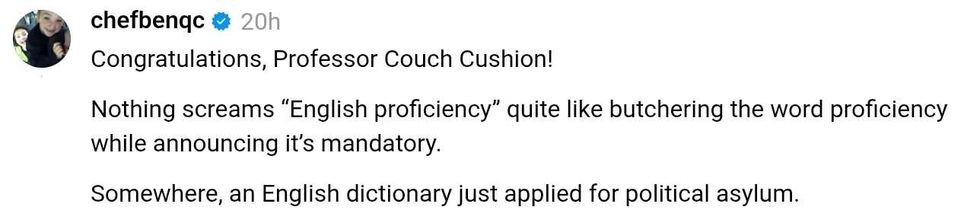 @chefbenqc/Threads
 @the_tre_haus; beckysolwold/Threads
 Ron Jarvis/Facebook
 @kasialove/Bluesky
 Barbara Boetsch/Facebook
 @maupt68/Threads
 @leftofliberal2025/Threads
 @pattistraus/Threads
 @sugarpillseattle/Threads