
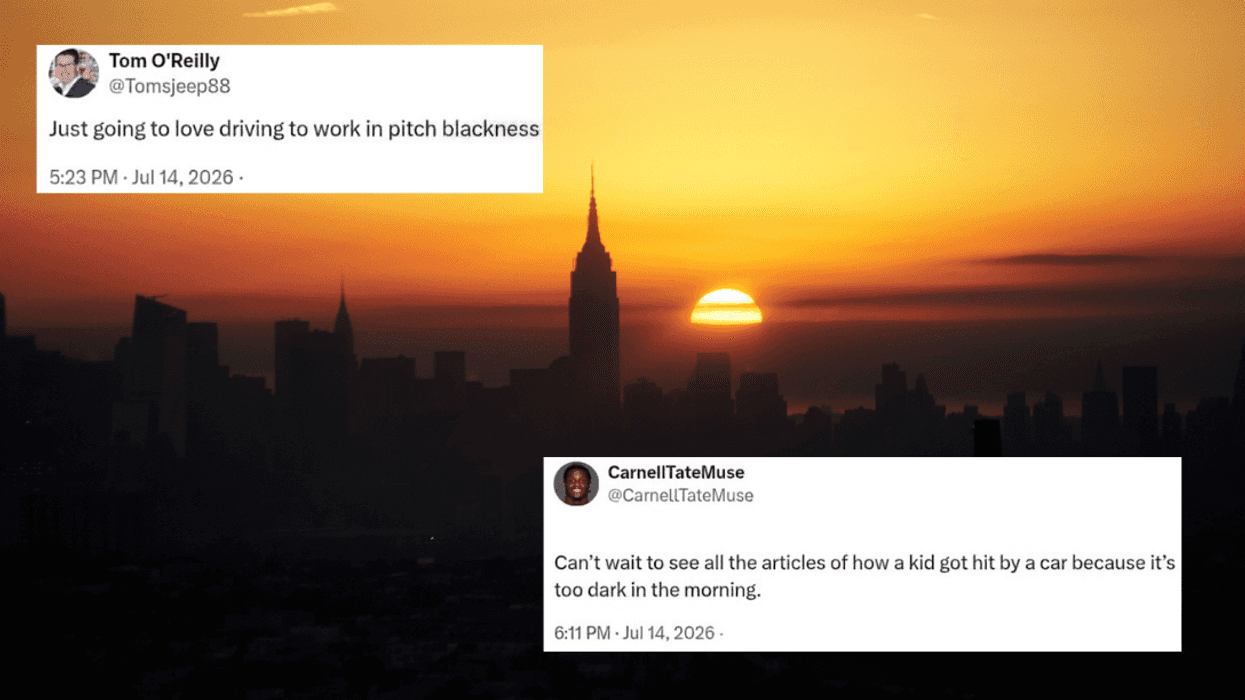

If you ask the average American why the United States observes Daylight Saving Time, they'll likely say it was invented by and for farmers. But anyone who grew up on a farm where the schedule is set by the livestock and the sun, not a clock, knows that reason doesn't hold water.
The global idea of "saving" daylight hours by shifting clocks back and forth depending on the season was first formally proposed in 1895 in New Zealand by entomologist George Hudson to prolong the hours that he could hunt for bugs. Unaware of that proposal, it was put to paper again by British builder William Willett in 1905 for the same purpose—prolonging the working day.
Prior to those two formal proposals, the idea had been bandied about in a 1784 essay by Benjamin Franklin as a means to save candle wax, but the premise was posed as a joke and not seriously considered.
The first implementation wasn't in the United States, either.
Daylight Saving Time (DST) was first officially adopted in 1916 by Germany and Austria to conserve fuel by reducing the need for artificial lighting during World War I.
The United States and Canada implemented DST in 1918, but it was still only sporadically used throughout the U.S. until Congress passed the Uniform Time Act of 1966. Since then, people have been complaining and debating its usage.
In 2024, then President-elect Donald Trump vowed on Truth Social that the GOP would abolish the clock adjustments. At the time, comparative maps showing sunrise and sunset times with and without DST went viral.
Now the Republican controlled House of Representatives has passed the Sunshine Protection Act to adopt DST full-time, meaning the abolishment of Standard Time, the clock setting normally used during winter months.
DST, which begins in the spring, means later sunrises and later sunsets. Standard Time, which we return to in the fall, means earlier sunrises and earlier sunsets.
Republicans shared the news on X after the vote to adopt DST year round took place.
And once again, a map showing what that would mean for mornings across the United States went viral.
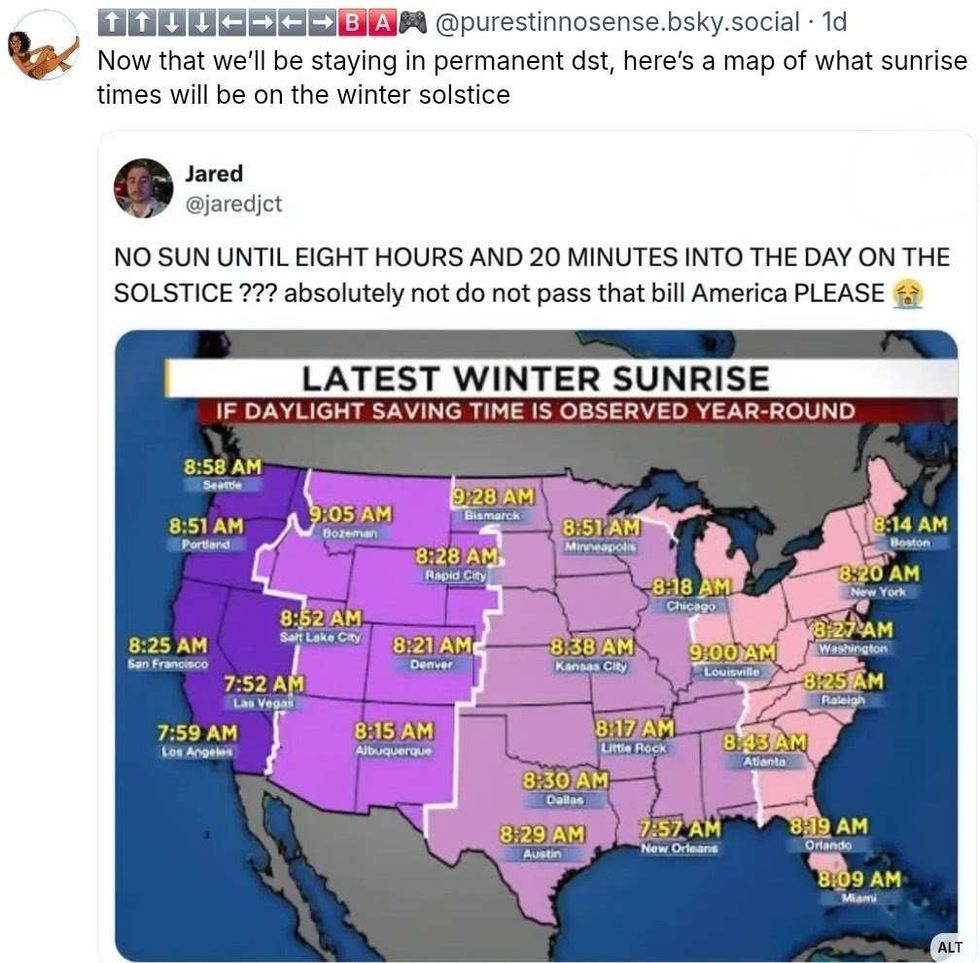
Many people weren't thrilled that the GOP opted for a longer work day (later sunset) than sunrises before 8:00AM in the winter.
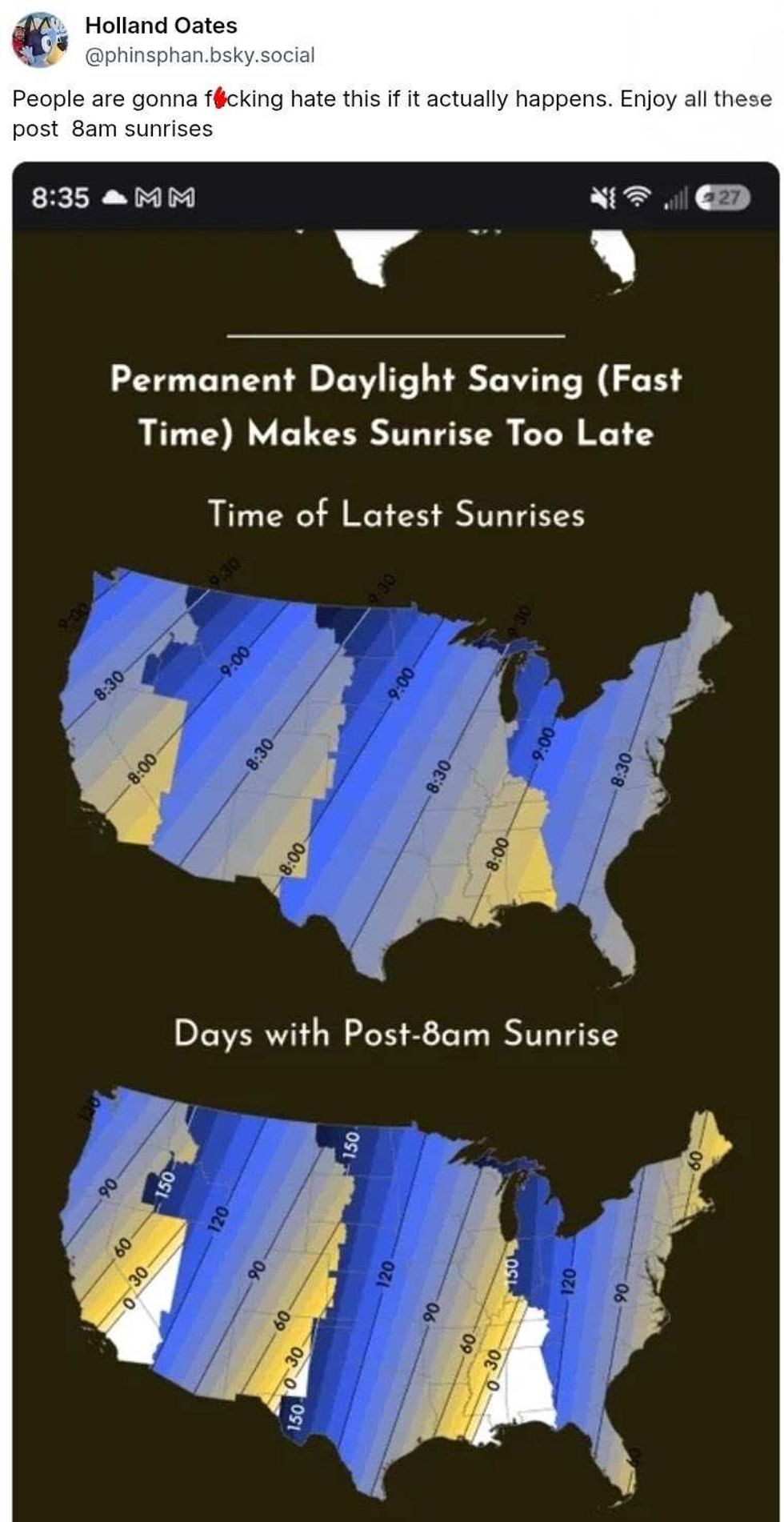 @phinsphan/Bluesky
 @burgwx/X
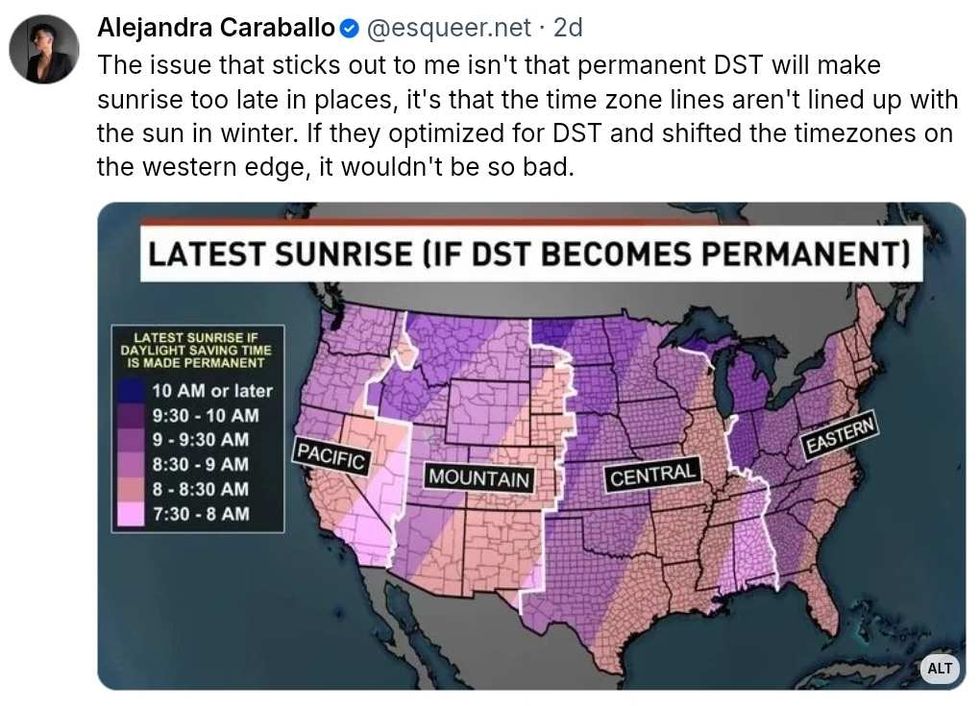 @esqueer.net/Bluesky
Scientific and medical research has shown the biannual time switch is detrimental to humans, disrupting the body's circadian rhythms. Dropping the time change enjoys widespread support, roughly two-thirds, across the political spectrum.
Hawaii and Arizona, with the exception of lands under the jurisdiction of the Navajo Nation, do not observe DST. Both have been on permanent Standard Time for decades.
Other states have explored eliminating the time change, while Maine—which has the first daily sunrises in the continental United States—has looked at leaving the Eastern time zone to join most of eastern Canada's Atlantic provinces in the Atlantic time zone.
The primary debate isn't about eliminating time changes, but rather should the United States stick to Standard Time all year or stick to DST year round.
Standard Time was developed in 1847 in Britain to standardize train schedules to minimize collisions, and adopted in the U.S. and Canada for the same purpose in 1883. It is calculated based on the path of the sun with Greenwich, England, as the center point and time being set as +/- Greenwich Mean Time heading East (-) and West (+) placing the point the time zones meet in the Pacific Ocean.
A competing House bill, the Sunshine for Our Kids Act would adopt Standard Time all year. It is unlikely to move forward until the permanent DST bill is defeated in the Senate or kicked back to the House after any Senate changes.











 @LadyPolitiks/X
 @_JeremyWrites
 @Coby_Hughes


 @vanessaskylar/Instagram
 @janaedunn/Instagram
 @youreadyjt/Instagram
 @sheisjules1/Instagram
 @bamabred2008/Instagram
 @denvervanessa/Instagram
 @bonjourclem/Instagram
 @chef.errok/Instagram
 @yozinha/Instagram
 @_micheladm_/Instagram
 @heanicolejar/Instagram
 @claudstravels/Instagram