
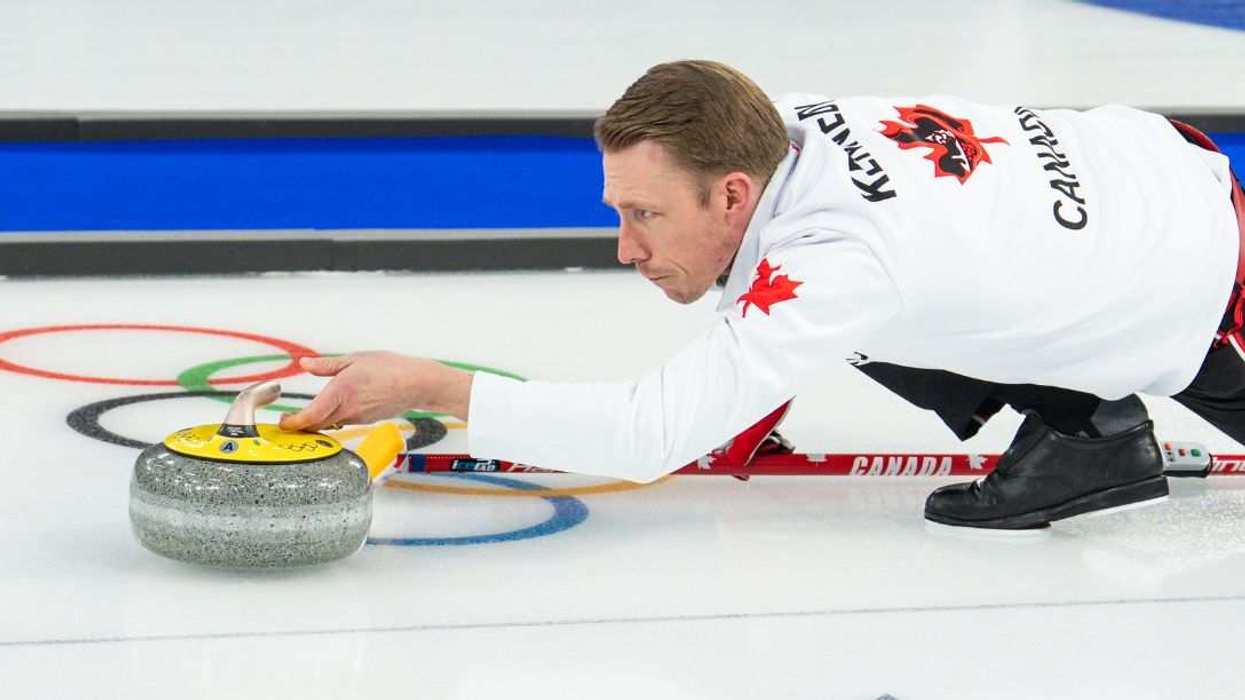

Last week at the Winter Olympics, tensions ran high when Team Canada faced Sweden in the men’s curling event. A cheating controversy erupted after Sweden’s Oskar Eriksson accused Canadian curler Marc Kennedy of illegally touching the granite portion of a curling stone rather than the handle, which the rules prohibit.
Sweden further alleged a “double touch,” which occurs when a player makes contact with the stone after it passes the hog line.
In curling, players slide 20-kilogram granite stones down a sheet of ice and must release the handle before the hog line. If contact continues beyond that line, the stone is removed from play. Because the handle contains electronic sensors, touching only the granite would not trigger the device.
The accusation came after the ninth end and was picked up on a hot mic.
Marc Kennedy fired back at Oskar Eriksson in an expletive-laced denial:
“I haven't done it once. You can f–k off.”
The moment, streamed live, stunned viewers and quickly spread online.
You can watch the controversial video here:
Despite Sweden’s objections, umpires upheld their ruling that Canada had not committed a violation. Kennedy did, however, receive a verbal warning for his language. Canada went on to win the match 8-6.
Still, Swedish players stood by their claims.
Oskar Eriksson reflected on what he believes is being lost in the sport:
“Curling should be a gentleman's sport. But perhaps it's come to a stage of professionalism where we drift away from that, as some people think it's too important to win.”
According to Sweden, Kennedy released the handle—disengaging the sensor—but kept a finger on the granite as the stone crossed the hog line, a marked boundary that players must clear before releasing the stone to keep it in play.
Niklas Edin laid out Sweden’s position bluntly:
“That's not allowed. It's pretty clearly stated. You don't touch 20kg of granite with your fingertips without feeling it; it's completely impossible.”
Curling officials stationed at either end of the sheet said they did not see a violation during play and therefore could not call one.
Edin explained the potential competitive impact:
“We, in the sport, know how very few grams of pressure can change the speed when it already has a movement forward. You can move some degree of the angle (too).”
World Curling, the sport’s governing body, said it would not use video replay to revisit calls already made by on-ice officials but pledged to assign observers to monitor deliveries more closely going forward.
The organization clarified the rule in a statement:
“During forward motion, touching the granite of the stone is not allowed. This will result in the stone being removed from play.”
Kennedy, for his part, rejected the accusation and framed his reaction as a matter of principle as an athlete.
He defended his record:
“I can’t think of once in my entire career where I’ve done something to gain a competitive advantage by cheating. So when you get called out, my instinct was to be a little bit of a bulldog.”
So don’t expect a Canadian “sorry” anytime soon, Team Sweden.
Social media quickly turned the controversy into a flood of side-by-side screenshots and slow-motion “analysis,” dissecting Kennedy’s finger placement frame by frame. The posts intensified scrutiny between the teams, as fans are split into digital camps—some defending Team Canada, others insisting the footage showed a violation—keeping the debate alive, both on and off the ice.
You can view the reactions and hilarious memes below:
The controversy also arrives at a sensitive moment for Canadian Olympic teams. For the second Games in a row, Canada has faced accusations over potential rule violations. At the 2024 Paris Olympics, the women’s soccer team was penalized after being caught using drones to spy on opponents.
Now, at the 2026 Milano Cortina Olympics, curling has entered that conversation.
Soon after the men’s curling dispute, Canada’s women’s team faced similar scrutiny. During a Saturday match between Canada and Switzerland, skip Rachel Homan had her rock removed for a double-touch violation. Great Britain’s Bobby Lammie also had a stone disqualified in a separate match against Germany, underscoring the increased enforcement across the field.
Rachel Homan expressed frustration after the ruling:
“I don't understand the call. I'll never understand it. … It has nothing to do with us.”
For a sport long associated with decorum, this episode seems to have struck quite a nerve. The so-called “Spirit of Curling” encourages players to call their own fouls, celebrate opponents’ good shots, and compete with mutual respect. The accusation, the hot-mic exchange, and the governing body’s clarification put that ethos under a microscope.
Whether the tense moment ultimately reshapes enforcement or simply lives on through Olympic memes, curling’s icy surface has rarely felt so heated.











 @JohnShoraka/X
 @gardengirl125/X


 @MeidasTouch/X
 @MeidasTouch/X