
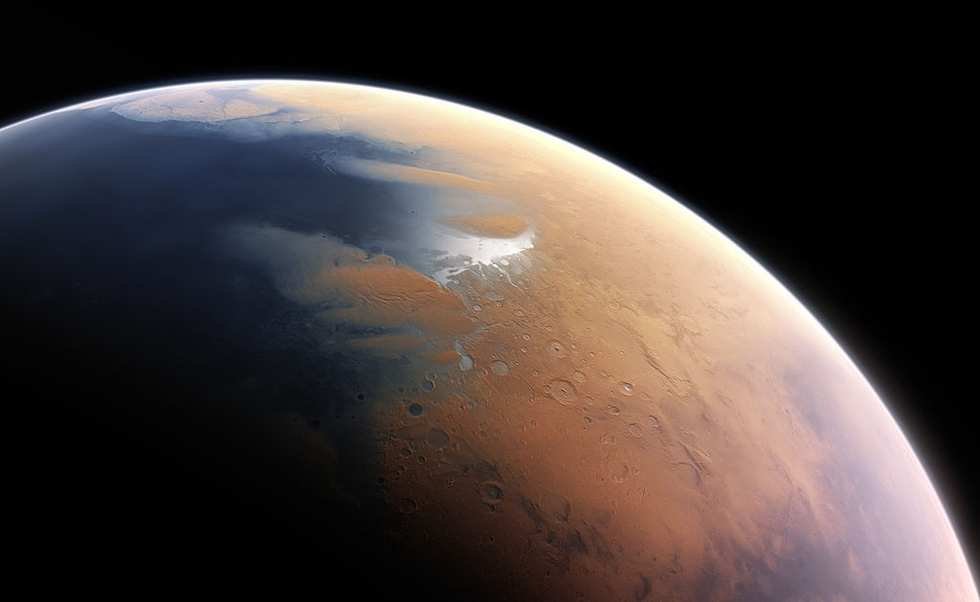

Just as science fiction author Ray Bradbury envisioned, NASA research strongly suggests the red planet was once green and covered by more oceans than found on Earth. So what happened to turn the fourth planet from the sun into a cold and barren crimson wasteland?
It was the sun that killed Mars. Violent solar winds stripped away the atmosphere over billions of years, leaving Mars naked and exposed to the harshness of space. Now NASA believes they can restore Mars to its former verdant glory — thus enabling the possibility of colonization — with the introduction of an artificial magnetic field. The magnetic field will allow the planet to develop an atmosphere, which in turn could help support life and liquid surface water in the future.
Magnetic fields essentially form a shield around planets, protecting them from charged particles that stream out from the Sun at an average of 400 kilometers (250 miles) per second. Occasionally, a hole in the corona shoots out a gust that moves the particles closer to a blazing 800 kilometers (500 miles) per second. These charged particles, known as solar winds, are normally deflected outward by the magnetic field lines resonating around a planet. While Earth has a strong magnetic field (due to its liquid metal core rotating rapidly every 24 hours), Mars does not.
The Northern Lights are a visible observation of the magnetic field at work, as it protects us from solar winds. The magnetic field sends the highly-charged particles spiraling toward the poles of our planet, and that interaction between the particles and the different gases in our atmosphere creates colorful displays in the sky.
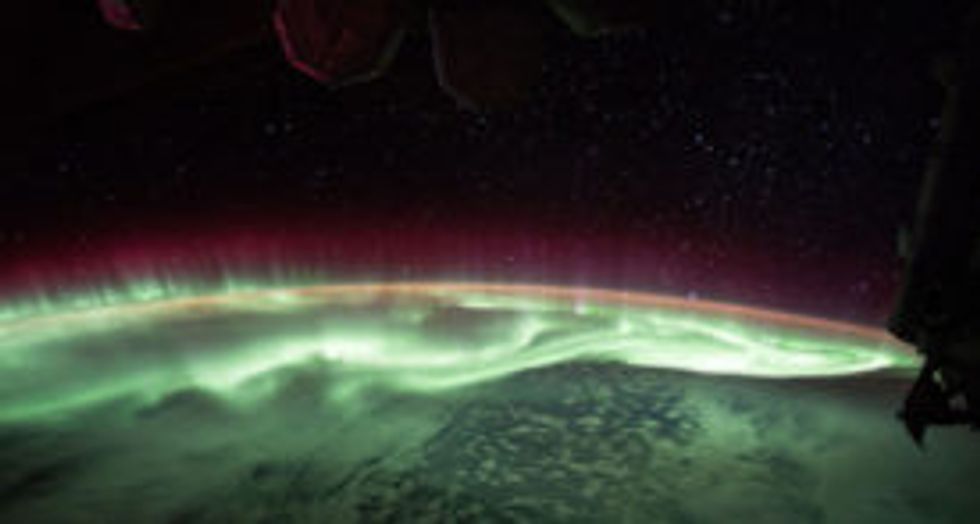 Auroras are triggered in Earth’s atmosphere by the solar wind, a constant stream of charged particles wafting away from the sun. Credit: NASA
A Vision of Solar System Exploration
Last February, NASA’s Planetary Science Division hosted the Planetary Science Vision 2050 Workshop at the NASA headquarters in Washington D.C. for the purpose of developing a long-range vision of what planetary science might look like in the future. Furthermore, they wanted to identify potential science goals and new technologies that would support the next phase of Solar System exploration. At the workshop, Director James Green presented their proposal for how to develop a future inhabitable Mars environment for science and exploration. Green’s accompanying paper describes what led to the red planet’s current condition:
“Today, Mars is an arid and cold world with a very thin atmosphere that has significant frozen and underground water resources. The thin atmosphere both prevents liquid water from residing permanently on its surface and makes it difficult to land missions since it is not thick enough to completely facilitate a soft landing. In its past, under the influence of a significant greenhouse effect, Mars may have had a significant water ocean covering perhaps 30% of the northern hemisphere.
“When Mars lost its protective magnetosphere, three or more billion years ago, the solar wind was allowed to directly ravish its atmosphere. The lack of a magnetic field, its relatively small mass, and its atmospheric photochemistry, all would have contributed to the evaporation and loss of its surface liquid water over time.”
Green and this team propose launching an “artificial magnetosphere” into space space between Mars and the Sun, creating a replacement magnetic shield that could then allow the red planet to restore its atmosphere. The paper explains in further detail:
“The magnetic field will be increased until the resulting magnetotail of the artificial magnetosphere encompasses the entire planet [...]. The magnetic field direction could also maintain an orientation that keeps it parallel with the impinging solar wind interplanetary field thereby significantly reducing mass, momentum, and energy flow into the magnetosphere and thus also damping internal magnetospheric dynamics.
“This situation then eliminates many of the solar wind erosion processes that occur with the planet’s ionosphere and upper atmosphere allowing the Martian atmosphere to grow in pressure and temperature over time.”
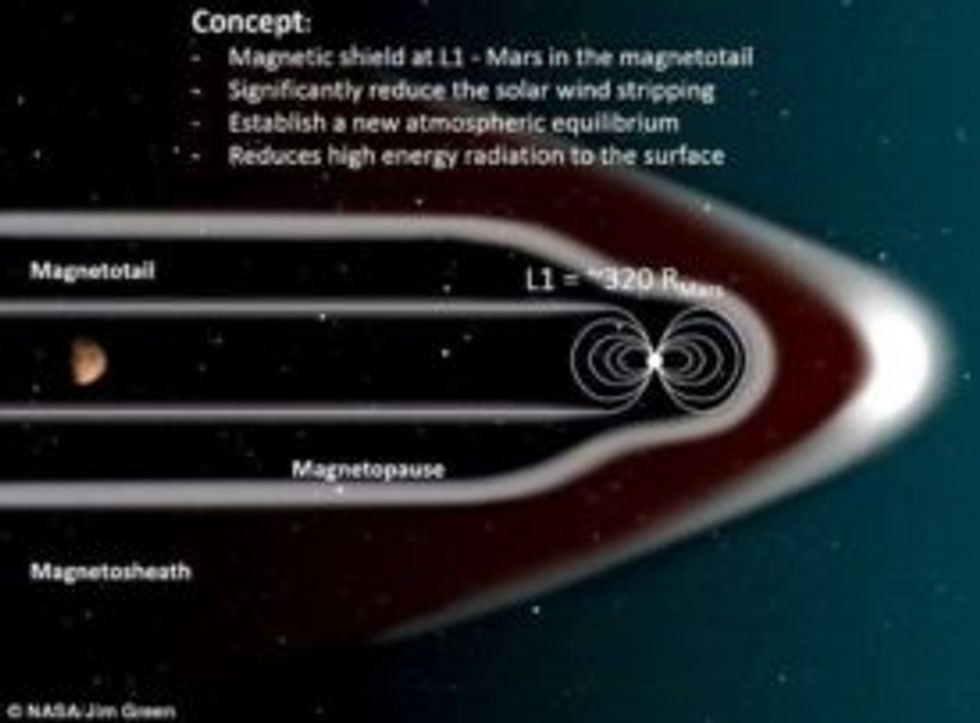 The powerful, closed electric circuit can be seen in front of Mars as well as the deviation of the charged particles from the solar wind away from Mars. As a result, an atmosphere can form on Mars because of this artificial magnetic field. Credit: Jim Green/NASA
Terraforming the Martian Climate for Colonization
While the concept seems more like science fiction, the science behind it already exists, just on a smaller scale. The Planetary Science Division looks to existing miniature magnetosphere research, which seeks to protect astronauts and their spacecraft from cosmic radiation, for the technology they will need to pull off this planet transformation. The team believes that if they build it to a larger scale, it could shield an entire planet.
“It may be feasible that we can get up to these higher field strengths that are necessary to provide that shielding,” said Green in his presentation. “We need to be able then to also modify that direction of the magnetic field so that it always pushes the solar wind away.”
Green projects that Mars could regain as much as half the atmospheric pressure of Earth’s in a matter of years, leading to a rise in temperature - enough to melt the carbon dioxide ice of the northern polar cap. The released carbon in the atmosphere will trap heat, just as it does on Earth, triggering a greenhouse effect that could melt Mars’ water ice. This would essentially terraform the Martian environment into a habitable climate for future generations of human colonists. Once more, the red planet could have coursing rivers and oceans.
“This is not terraforming as you may think of it where we actually artificially change the climate, but we let nature do it, and we do that based on the physics we know today, Green said. “If this can be achieved in a lifetime, the colonization of Mars could not be far away.”
https://thesocialedgen.wpengine.com/science/mit-wins-mars-design-prize/
https://thesocialedgen.wpengine.com/science/mars-2020-rover-oxygen/
https://thesocialedgen.wpengine.com/science/scientists-observed-snowstorms-mars/





 @Milbank/X






 reply to @girlcodelettie/TikTok
 reply to @girlcodelettie/TikTok
 reply to @girlcodelettie/TikTok
 reply to @girlcodelettie/TikTok
 reply to @girlcodelettie/TikTok
 reply to @girlcodelettie/TikTok
 reply to @girlcodelettie/TikTok
 reply to @girlcodelettie/TikTok
 reply to @girlcodelettie/TikTok
 @calebs_creative_arts/Instagram
 @drew.brooks15/Instagram
 @mehmoodment/Instagram
 @jojokw_/Instagram
 @yos_marro6/Instagram
 @_j.o.u.r.n.e.y._/Instagram
 @ashton_bedford_86/Instagram
 @lindentreethesea/Instagram
 @logolepsykid/Instagram
 @chef1017/Instagram
 @christinacac95/Instagram
 @iamvelissimo/Instagram

 u/cheerychacha/Reddit
 u/bibidumb/Reddit
 u/MDagg77/Reddit
 u/wefeellike/Reddit
 u/filmstvwatching/Reddit
 u/Cat-Dawg/Reddit
 @notmanabu/Instagram
 @ilovutony/Instagram
 @candidcaleb/Instagram
 @cherry_nz9296/Instagram
 @emilyayley/Instagram
 @flossedinparadise/Instagram