
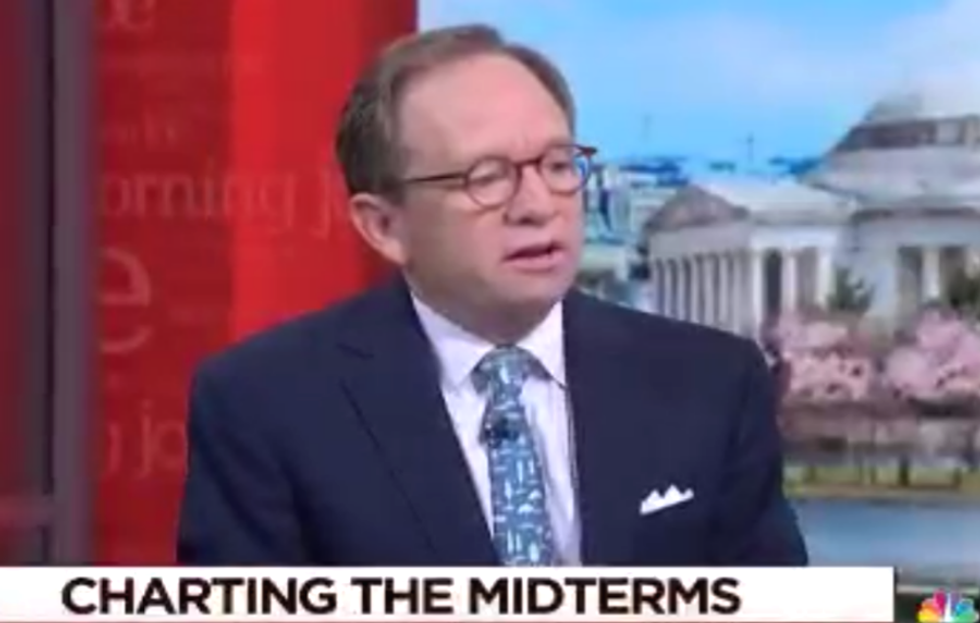

In an appearance on MSNBC's Morning Joe Wednesday, economic analyst Steve Rattner discussed the potential "blue wave" headed for the 2018 midterm elections. He charted several factors that could contribute to a red to blue flip in Congress during voting on November 6, 2018.
Overall, based on previous midterm election results dating back to 1970, things looked better for Democrats than Republicans.
Voter apathy, which Rattner did not specifically address, also contributes heavily to midterm election results. More people vote during presidential election years than during the middle of a presidential term.
First, Rattner charted the relationship between presidential approval ratings and midterm election results in the House of Representatives. When presidential approval is lowest, the House—which puts all 435 members up for reelection every 2 years—loses more seats from the President's party.
In years the opposing party holds more seats than an unpopular President, fewer seats are lost by that opposition party. An unpopular President also motivates more voters to go to the polls during midterms.
Rattner then discussed the rash of retirements among Republican incumbents leading up to the next election cycle. Incumbents enjoy an 85 percent reelection rate over their challengers.
Those incumbents not seeking reelection include Speaker of the House Paul Ryan of Wisconsin. Ryan announced his retirement in April.
Some speculated Ryan intended to distance himself from Washington so he could run for President in 2020. But others wondered if Ryan knew he faced not getting reelected, a defeat which would damage his future in politics.
At 41 Republican retirements, an historically high number Rattner stated to the best of his recollection, Democrats gain an advantage.
Lastly, Rattner shared an analysis done by The Economist. The magazine ran 10,000 simulations based on multiple variables to try to predict the November election results.
Based on their number crunching, The Economist predicted a 71 percent chance of the House going from Republican control to Democratic control during the midterms.
If Democrats retain all of their current House seats, they need to pick up only 23 more seats to flip the House of Representatives from red to blue.
Some online were cautiously optimistic about Democratic chances in November in these Twitter responses to Rattner.
Others brought up factors Rattner only touched on, such as gerrymandering and voter apathy.
One thing is indisputable, however. People who don't vote, don't influence elections. Midterm elections take place Tuesday, November 6, 2018.











 @joannawietrzyk/Instagram
 reply to @joannawietrzyk/Instagram
 reply to @joannawietrzyk/Instagram
 reply to @joannawietrzyk/Instagram
 reply to @joannawietrzyk/Instagram
 reply to @joannawietrzyk/Instagram
 reply to @joannawietrzyk/Instagram
 reply to @joannawietrzyk/Instagram
 reply to @joannawietrzyk/Instagram
 reply to @joannawietrzyk/Instagram