
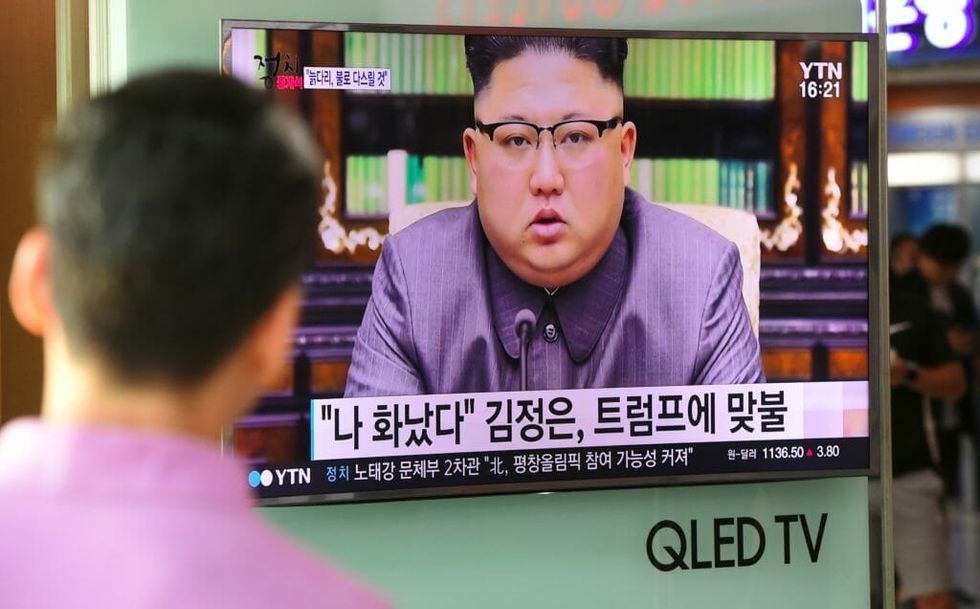

North Korea's nuclear tests are politically scary. But the fallout from the tests has broad-ranging impacts beyond potential nuclear war. The six nuclear tests performed so far have already weakened the geological landscape and harmed human health.
It has long been known that radiation from nuclear testing can cause cancer. It is associated with most forms of leukemia, as well as cancer of the thyroid, lung, and breast. When nuclear tests are performed underground—as North Korea’s six tests have done so far—much of the radiation is contained, protecting the environment and individuals around it.
However, a fissure or crater can cause dangerous amounts of radiation to leak. To date, all six of North Korea’s nuclear tests have taken place at a site called Punggye-ri in the province of North Hamgyong. Satellite images show numerous landslides throughout the Punggye-ri Nuclear Test Site, particularly after the sixth nuclear test.
According to 38 North, an academic website on Korea run by John Hopkins University, there also appears to be increased water drainage in one area, brought about by the expansion of existing cracks and fissures. They expect that this, in turn, will aid in the transport of cancer-causing radionuclides to the surface.
This finding is consistent with a recent report out of South Korea that found traces of xenon gas, a radionuclide, five days after North Korea’s final nuclear test on September 3. Said Suh Kyun-ryul, a professor of nuclear engineering at Seoul National University, “Due to the collapsed ground layer, fissures must have formed underneath, leading to contamination of the underground layer and water supply.”
While it is difficult to get reports from North Korea since reporters are not allowed in, defectors from North Korea tell of the effects the nuclear tests have already had on the area. Defectors report the death of 80 percent of trees that are planted in Kilju, the nearest sizable city to the testing site. They also report that with the sixth explosion, underground wells have run dry. Trout and pine mushrooms, once local specialties, have been gone since the first test in 2006.
The human carnage has also already begun. Officials do not warn locals before conducting the tests. One defector who escaped North Korea in 2010, after the first two tests, said: “Prior to nuclear tests, around two tests involving only detonators take place, and locals are mobilized to dig deep holes for those tests. I personally saw corpses floating down the river with their limbs severed.”
Given that the people in Kilju drink water coming down from Mt. Mantap in Punggye-ri, locals are concerned about contamination. There are already reports of babies being born with birth defects. However, the extent of illness from the tests is unknown as officials work hard to keep accounts from Kilju from spreading. “People who boarded trains to the border with samples of soil, water and leaves from Kilju county were arrested and sent to prison camps,” said one source.
While the effects are already grim, should North Korea decide to run an atmospheric nuclear test, as they have threatened, things would get much worse. Without an underground buffer, the classic mushroom-cloud shaped test spreads a radioactive cloud to all in its path, with winds spreading the destruction even further.
A 1991 study by the International Physicians for the Prevention of Nuclear War estimated that the radiation from atmospheric testing would cause 430,000 cancer deaths by the year 2000, with more than 2.4 million people eventually dying from cancer as a result of the testing. This is so even though the last atmospheric test was done by China almost 40 years ago. The United States, Britain and the Soviet Union banned them more than 50 years ago.
“Underground tests are not environmentally friendly, but there is a vast difference between conducting them in the ground or in the atmosphere,” said Daryl Kimball, executive director of the Washington-based Arms Control Association. “If North Korea follows up on the threat to conduct a nuclear test explosion over the Pacific, that would be completely different.”





 @fryer.michelle/Instagram
 @leslied348/Instagram
 @alexander.siu/Instagram




 @GracieUSA1/X
 @MobiusDick/X
 @LizLamb35924538/X
 @Def_Bassman/X
 @SweetSindy1982/X