
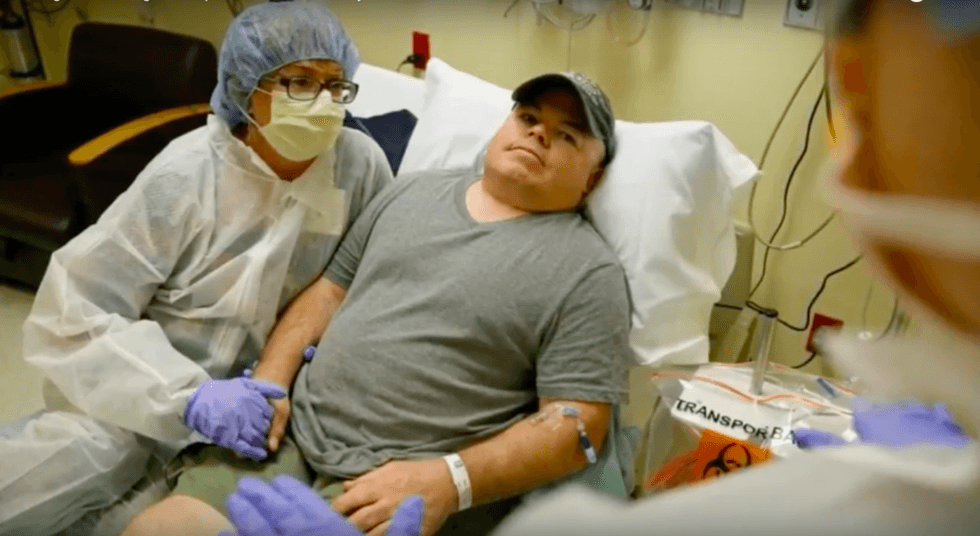

Our DNA has the power to unlock endless stories of who we are and where we came from, but what if we could change it forever? 44-year old Brian Madeux may be among the first to know: Last month, Madeux was the first individual to receive in-body gene editing, in an attempt to treat his Hunter Syndrome, a rare metabolic condition tied to a genetic mutation.
To carry out this groundbreaking therapy, scientists flooded Madeux’s body via IV with billions of copies of a corrective gene, as well as with a gene editor known as zinc finger nuclease (ZFN), intended to insert the new gene into his DNA.
Never before has an individual received permanent in-body DNA alterations to treat a genetic condition. Previously, scientists have tried altering cells in the lab, later injecting them into patients’ bodies, and have conducted a range of gene therapies that don’t involve altering DNA. However, these methods often provide only temporary or limited relief from many genetic conditions.
In contrast, any edits made using ZFN are immediate and irreversible: “We cut your DNA, open it up, insert a gene, stitch it back up. Invisible mending. It becomes part of your DNA and is there for the rest of your life,” explains Dr. Sandy Macrae, president of Sangamo Therapeutics, the California-based company behind Madeux’s procedure. Sangamo also plans to test ZFN’s success in treating hemophilia and other metabolic conditions.
ZFN therapy operates in several stages: scientists first insert instructions on how to activate zinc finger nucleases, which operate much like scissors slicing DNA, into a virus that’s altered to be harmless to human hosts. They then inject billions of copies of that virus, as well as a corrective gene, into the individual, where, following instructions, the virus travels to the liver. Once there, the virus spurs liver cells to create ZFN, which in turn trims the patient’s DNA at the precise site of a mutated gene, freeing up space for the corrective genes to enter the DNA.
As a monogenetic disorder, or one involving a mutation in just one gene, Hunter Syndrome provides a simple blueprint for researchers to test the therapy before moving on to conditions involving multiple mutations. Individuals suffering from Hunter are missing a gene that is key to producing an enzyme needed to process certain carbohydrates. The resulting build-up of carbs in their cells leads to widespread and permanent damage—everything from facial distortion and issues with bones, joints and bowels to problems hearing, seeing, breathing and thinking.
“Many are in wheelchairs...dependent on their parents until they die,” said Dr. Chester Whitley, a University of Minnesota geneticist who has studied those with the condition. While weekly IVs infusing patients with the missing enzyme can slow the damage, they run between $100,000 to $400,000 a year, and can’t stave off long-term brain damage.
Madeux was the first of about 30 individuals with Hunter Syndrome scheduled to receive this form of gene editing therapy. Participants’ long-term results will help determine if the technique is safe for humans, as the FDA has not yet approved the therapy. If deemed safe and successful, scientists plan to treat Hunter-afflicted children with the gene editing therapy soon after diagnosis, before they incur long-term damage from the condition.
Earlier gene therapies raised a host of concerns, from worries that newly inserted genes could have unforeseen impacts on other genes’ behavior, to fears that the virus used could spark an immune system attack or lay dormant in places like the heart, eggs or sperm. Still, prior testing of the ZFN editor on mice and primates indicated positive results overall, and researchers who surveyed the study say that despite the concerns, the benefits gene editing could unlock vastly outweigh possible consequences.
Said Dr. Howard Kaufman, a Boston scientist on the National Institutes of Health panel that approved the study to move forward: “So far there’s been no evidence that this is going to be dangerous. Now is not the time to get scared.”
Only time will tell if this revolutionary new treatment proves to be a long-term success for Brian Madeux: two to three months after the November 13 procedure, tests on the enzyme levels within his white blood cells and a liver biopsy should indicate whether the corrected gene has integrated successfully. Dr. Paul Harmatz, Madeux's doctor and the principal investigator for this treatment, remains concerned that the dose may not have been potent enough, as after the initial infusion, patients grow immune to the virus used to deliver the corrective genes into the body: “You have one shot, one chance to have an effective therapy."
For his part, Madeux remains optimistic that the treatment will drastically change his life along with his DNA: “I’ve been waiting for this my whole life, something that can potentially cure me.”





 Brendan Smialowski/AFP via Getty Images
 Brendan Smialowski/AFP via Getty Images
 Brendan Smialowski/AFP via Getty Images





 @hannahhrevels/TikTok
 @hannahhrevels/TikTok
 @hannahhrevels/TikTok
 @hannahhrevels/TikTok
 @hannahhrevels/TikTok
 @hannahhrevels/TikTok
 @hannahhrevels/TikTok
 @hannahhrevels/TikTok
 @hannahhrevels/TikTok
 @hannahhrevels/TikTok
 @hannahhrevels/TikTok
 @hannahhrevels/TikTok
 @Raye455/X
 @JoJoFromJerz/X
 @phlynnmartin/TikTok
 @phlynnmartin/TikTok
 @phlynnmartin/TikTok
 @phlynnmartin/TikTok
 @phlynnmartin/TikTok
 @phlynnmartin/TikTok
 @phlynnmartin/TikTok
 @phlynnmartin/TikTok
 @phlynnmartin/TikTok
 @phlynnmartin/TikTok
 @phlynnmartin/TikTok
 @sailors.mama/TikTok
 @sailors.mama/TikTok
 @sailors.mama/TikTok
 @sailors.mama/TikTok
 @sailors.mama/TikTok
 @sailors.mama/TikTok
 @sailors.mama/TikTok
 @sailors.mama/TikTok
 @sailors.mama/TikTok
 @sailors.mama/TikTok
 @sailors.mama/TikTok
 @sailors.mama/TikTok