
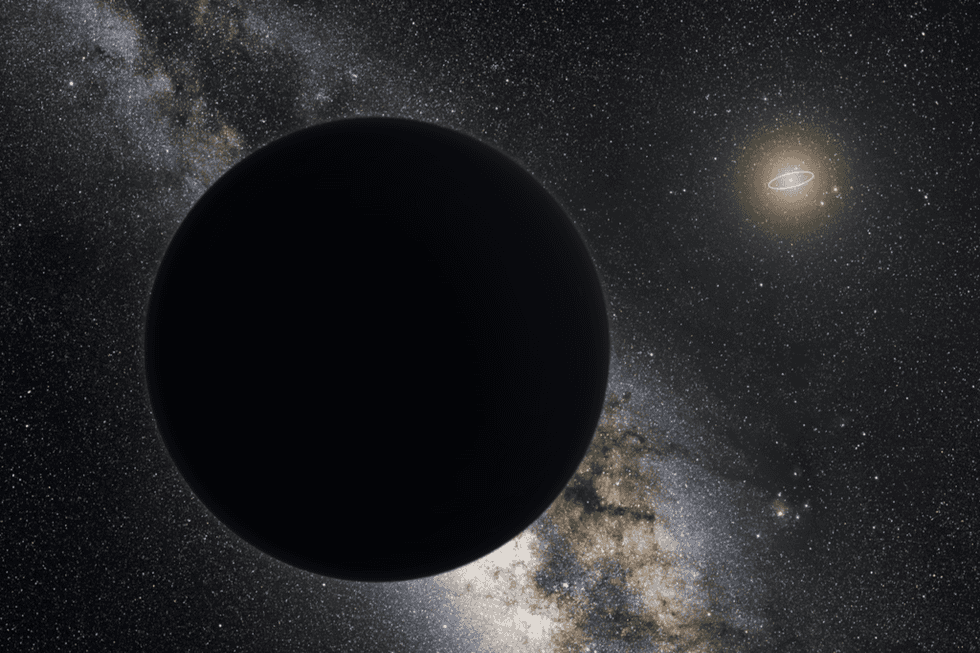

The solar system has eight planets, right? Not according to new research out of Caltech, which NASA seems to agree with. Recent scientific discoveries may confirm the existence of a giant ninth planet far beyond the orbit of Neptune. Conspiracy theories and ancient mythologies, like the Sumerian tales of Nibiru, tell of a large ninth planet wandering around our solar system, causing orbits to be perturbed and life on Earth to be cyclically wiped out. For example, the ancient Sumerians believed humanity was created as a slave race for the Annunaki, who came to Earth to mine gold to save their dying planet, Nibiru. Scientists now believe there is indeed a ninth planet, based on astronomical observations. At least, that’s what NASA is claiming.
By the way, Pluto is not the ninth planet. Pluto is five times smaller than Earth’s Moon, and was appropriately downgraded to dwarf planet status in 2006 by Caltech astronomer Mike Brown. It is one of potentially hundreds of thousands of dwarf planets in the Kuiper Belt.
Say what?
It’s not Pluto, but lurking in the dark outer reaches of our solar system, twenty times farther from the Sun than Neptune, is what NASA claims is a large ninth planet. On October 4, 2017, NASA issued a press release claiming that a massive, invisible planet best explains gravitational and orbital anomalies in the outer solar system. Planets don’t emit their own light, and because Planet Nine is so far away, it’s too dark to view directly. It is possible, however, that current telescopes could see Planet Nine in the future, for example if light from the Sun is reflected off its atmosphere or surface at the right time and angle to make it visible from Earth. “There are now five different lines of observational evidence pointing to the existence of Planet Nine," said Caltech planetary astrophysicist Konstantin Batygin, who along with Caltech astronomer Mike Brown, co-authored a 2016 study of Kuiper Belt objects. The Kuiper Belt contains trillions of leftover objects from the formation of our solar system, such as comets and dwarf planets like Pluto and Sedna (which are also known as “trans-Neptunian” objects). It’s shaped like a disc and lies beyond the orbit of Neptune.
Planet Nine is also responsible for the precession, or tilt, of our solar system’s axis. NASA estimates that Planet Nine is about 10 times as massive as Earth, making it a rocky “super-Earth” (more on super-Earths later). It has a wide elliptical orbit that takes it as far as 100 billion miles from the Sun.
Gravitational and orbital anomalies
The existence of Planet Nine best explains various gravitational and orbital anomalies of objects in the Kuiper Belt. In a survey of the six most distant known objects in our solar system with orbits exclusively beyond Neptune, Batygin and Brown found that the distant icy bodies “all have elliptical orbits pointing in the same direction [relative to the plane of the planets].” Gravity from hypothetical Planet Nine explains why these objects have a relative tilt of 30 degrees downward, relative to the planets. They simply mirror Planet Nine’s orbital path, due to the pull of its gravity. Planet Nine’s supposed gravity, according to Batygin, should also result in objects with orbital tilts of up to 90 degrees. Sure enough, five known Kuiper Belt objects exert this behavior as well. In addition to their extreme tilt, these Kuiper Belt objects orbit the Sun in the opposite direction as the planets, suggesting a strong source of gravity. Batygin and Brown’s observations confirmed the predictions made by their computer models; that a super-Earth with a highly elliptical orbit best explains the confluence of these anomalies.
To keep reading, continue to page 2...
Additional compelling evidence for Planet Nine also appears from the apparent tilt of the orbital plane of the planets, relative to the Sun’s equator. Like the wild orbits of Kuiper Belt objects, the cause of the six-degree tilt is best explained by Planet Nine. Caltech astrophysicist and planetary scientist Elizabeth Bailey completed a study in 2016, in which computer simulations concluded that Planet Nine’s gravity, over the course of the 4.5-billion-year history of the solar system, could have caused the orbits of the planets to tilt. “All these other ways to explain why the solar system is tilted are really hard to test — they all invoke processes that were possibly present really early in the solar system," Bailey said in her study. "Planet Nine is the first thing that has been proposed to tilt the solar system that doesn't depend on early conditions, so if we find Planet Nine, we will be able to see if it's the only thing responsible for the tilt, or if anything else may have played a role."
Planet Nine is a super-Earth
A super-Earth is a rocky planet with slightly more or substantially more mass than Earth, though scientists believe that planets with much more than 1.6 times Earth’s radius can no longer be rocky. The nomenclature can be deceiving, however. Just because a planet is rocky and similar in size to Earth, doesn’t mean it can host life on its surface. Planet Nine is probably no exception to this, since it’s likely extremely cold due to its distance from the Sun.
Despite numerous super-Earths having been discovered around other stars, none appear to be capable of sustaining human life. Some super-Earths could be entirely covered in water, such as planet Kepler-62f. Some are too close to their stars to be able to sustain life, like the first confirmed rocky super-Earth, Kepler-10b. Super-Earths are common; most solar systems have them, and therefore it’s likely that our solar system is no exception. Because of their mass, super Earths have a stronger gravitational pull than Earth-sized planets. The increased gravity makes it unlikely that intelligent life as we know it would have arisen, as more gravity means anything crawling around on the surface would probably be short and wide, though this doesn’t necessarily negate the possibility of intelligence evolving in some form.
Imagine it!
Giving Planet Nine a formal name would require approval of the International Astronomical Union, and surely the lucky discoverer will have a say. But if there is indeed a ninth planet out there, what could it be like? Planet Nine, should it exist, would receive very little light from the Sun, due to its extreme distance. Besides being really cold, one could imagine a large, rocky world with active volcanoes and plate tectonics, assuming it has a molten core like Earth (this seems likely, given most large planets have hot cores due to their mass and gravity). Planet Nine could have cryovolcanoes, like those found on Saturn’s moon Enceladus. Maybe Planet Nine is a water world, with a global liquid water ocean underneath a circumplanetary ice sheet. Perhaps under that ocean are geothermal vents, like the vents found at the bottom of Earth’s oceans, and maybe, just like on Earth, those vents could help life arise. Conversely, Planet Nine could be a cold, dead rock with a fleeting atmosphere of nothing but noble gases. It could even be so cold that any atmospheric gases, such as water vapor from cryovolcanoes, freeze and precipitate onto the surface.
Of course, confirmation of any of this requires direct observation. Assuming recent studies are correct, our solar system is no exception to having a super Earth. If Planet Nine really is out there, its secrets are about to be revealed.











 @fallontonight/Instagram
 @fallontonight/Instagram
 @fallontonight/Instagram
 @fallontonight/Instagram
 @fallontonight/Instagram
 @fallontonight/Instagram
 @fallontonight/Instagram
 @fallontonight/Instagram
 @fallontonight/Instagram
 @fallontonight/Instagram
 @fallontonight/Instagram
 reply to @honeymoon/Instagram
 r/popculturechat/Reddit
 r/popculturechat/Reddit
 r/popculturechat/Reddit
 r/popculturechat/Reddit
 r/popculturechat/Reddit
 r/popculturechat/Reddit
 r/popculturechat/Reddit
 r/popculturechat/Reddit
 r/popculturechat/Reddit
 r/popculturechat/Reddit
 r/popculturechat/Reddit
 r/popculturechat/Reddit
 r/popculturechat/Reddit
 r/popculturechat/Reddit
 r/popculturechat/Reddit
 r/popculturechat/Reddit
 r/popculturechat/Reddit
 r/popculturechat/Reddit
 r/popculturechat/Reddit
 r/popculturechat/Reddit
 r/popculturechat/Reddit