
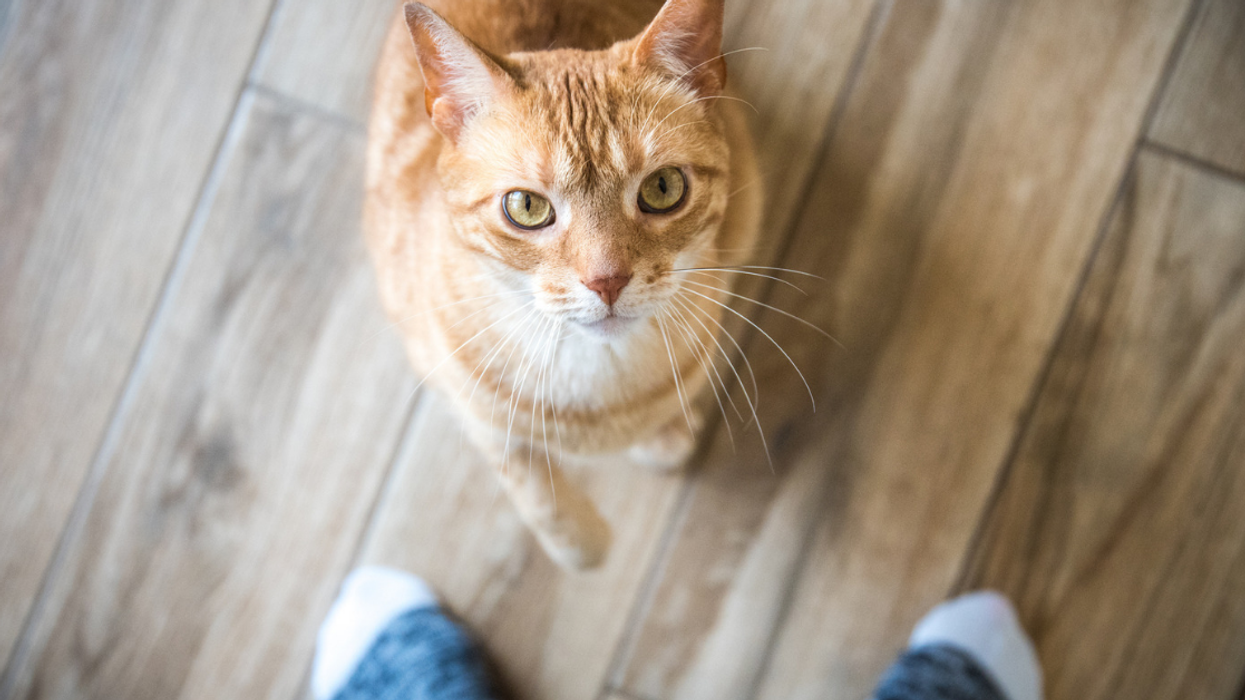

Vindication for cat owners: Cats can recognize their own names, according to the authors of a study published in the journal Scientific Reports.
Scientists in Japan observed a total of 78 domesticated cats.
Some were in households. Others were in a cat cafe where they lived.
The pet owners and said said the animals' names, as well as nouns with a similar length and rhythm, and the names of other cats in four separate experiments:
"In Experiment 1, we investigated whether cats can discriminate their own names from general nouns with the same length and accents as their own names. If cats can discriminate their own names from other words by using phonetic characteristics other than length of or accent of stimuli, cats habituated to the other 4 words should show dishabituation when hearing their own names."
"The test cats were living either with no other cats or with a small number of other cats. In this experiment, although we equalized the familiarity of the nouns, the relative familiarity of names and other nouns was markedly different, that is, cats heard their own names more frequently than other nouns. Therefore, cats discriminated their own names depending both on phonetic characteristics and on familiarity."
"In Experiment 2, we investigated cats' ability to discriminate their own names from other cats' names, by using cats living with 4 or more other cats. It can be assumed that the test cats were exposed to the other cats' names as well as their own names; stimuli were prepared using cohabiting cats' names."
"Then, in Experiment 3, we examined effects of multiple-cat living environments on discrimination of general nouns and cats' own names, similar to Experiment 1. In Experiments 2 and 3, we tested cats both from ordinary households and from a 'cat café', a business establishment where visitors can freely interact with cats. In Experiments 1 to 3, stimuli used cats' owners' own voices, because they exhibit a marked response to their owner's voice17. However, this leaves open the possibility that cats can discriminate their own names only when their owners utter them."
"Thus, in Experiment 4, we tested whether cats can discriminate their own names from general nouns even when unfamiliar persons utter them; if they showed discrimination ability in this experiment, we would take them to recognize their own names based on common phonetic characteristics in human verbal utterances."
Their verdict: Cats recognize their names.
"We used a habituation-dishabituation method to investigate whether domestic cats could discriminate human utterances, which consisted of cats' own names, general nouns, and other cohabiting cats' names."
"Cats from ordinary households and from a 'cat café' participated in the experiments. Among cats from ordinary households, cats habituated to the serial presentation of four different general nouns or four names of cohabiting cats showed a significant rebound in response to the subsequent presentation of their own names; these cats discriminated their own names from general nouns even when unfamiliar persons uttered them. These results indicate that cats are able to discriminate their own names from other words."
"There was no difference in discrimination of their own names from general nouns between cats from the cat café and household cats, but café cats did not discriminate their own names from other cohabiting cats' names. We conclude that cats can discriminate the content of human utterances based on phonemic differences."
So if cats recognize their names... that means they've been ignoring us this whole time.
Although the poet TS Eliot claimed, in his poem The Naming of Cats, every cat possessed three names: the formal name given by their human family, the informal names that family calls the cat every day and the name the cat gave to itself that only the cat knows.
You can read more of Eliot's musings on cats here, in his book Old Possum's Book of Practical Cats., the inspiration for the musical Cats, available here.
"Many cat owners know that cats understand their own names. However, there are no scientific evidence about that ability," Dr. Atsuko Saito, co-author of the study at the Department of Psychology, Faculty of Human Sciences at Sophia University in Japan told Newsweek.
"There are so many studies about dog ability to communicate with humans. We think it is important to show the abilities of cats."
Saito acknowledged the researchers could have expanded the study by including cats from more than one cat cafe.
She said:
"Results from the cat cafe may be difficult to generalized to other cats from other cat cafe."
We're on to you, cats, not that we'll actually do anything about it.
We know very well who's in charge.





 reply to @fievel42/Instagram
 reply to @fievel42/Instagram
 reply to @fievel42/Instagram
 reply to @fievel42/Instagram
 reply to @fievel42/Instagram
 reply to @fievel42/Instagram
 reply to @fievel42/Instagram
 reply to @fievel42/Instagram
 reply to @fievel42/Instagram
 reply to @fievel42/Instagram
 reply to @fievel42/Instagram
 reply to @fievel42/Instagram
 reply to @fievel42/Instagram
 reply to @fievel42/Instagram
 reply to @fievel42/Instagram








 @realDonaldTrump/Truth Social