
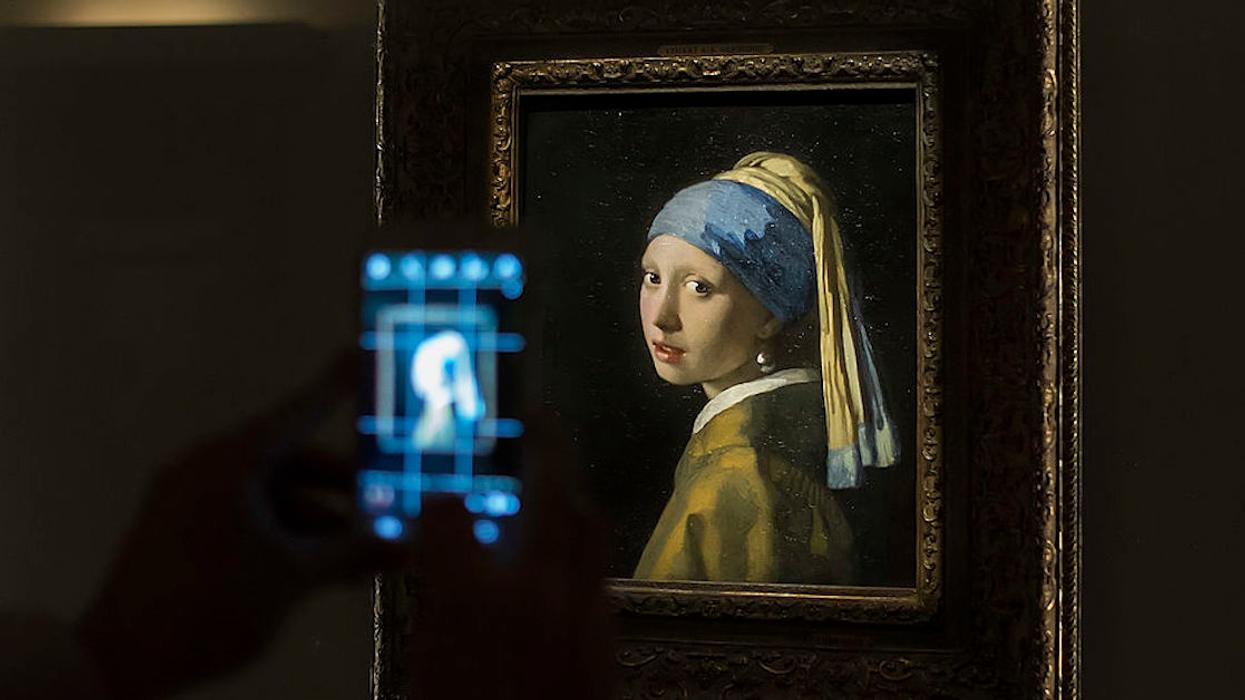

Researchers have used a battery of modern imaging techniques to get under the skin of Johannes Vermeer's Girl with a Pearl Earring, but tests have not answered the key question about the famous painting's enigmatic subject.
Martine Gosselink, director of the Mauritshuis museum in The Hague, in an online presentation of new research findings asked:
"Who was the girl?"
“Spoiler alert: No, sadly we didn't find out who this young lady was and if she ever really existed. But we did get a little closer to her."
What the 2018 research project did uncover were details including how the Golden Age Dutch master painted the girl and where he got his pigments, including some from the Peak District.
They even confirmed that the girl had eyelashes and she was painted in front of a green curtain that has faded from view. Such is the interest in the painting, that even the subject's facial hair—or apparent lack of it—is the subject of academic debate.
The eyelashes were not the only hairs researchers found. Microscopic scans also revealed tiny fragments from Vermeer's paintbrushes embedded in the girl's skin.
The painting was placed in a purpose-built glass room in early 2018 so visitors to the museum could watch as researchers and their hi-tech machines took what amounted to a full-body scan of the work completed by Vermeer around 1665, which is sometimes referred to as the Dutch Mona Lisa.
The public will have to wait until they can see the museum's star painting in real life. The Mauritshuis, along with all other Dutch museums and galleries, is closed due to restrictions aimed at slowing the spread of the coronavirus.
The research findings were being placed online, with explanations from those involved.
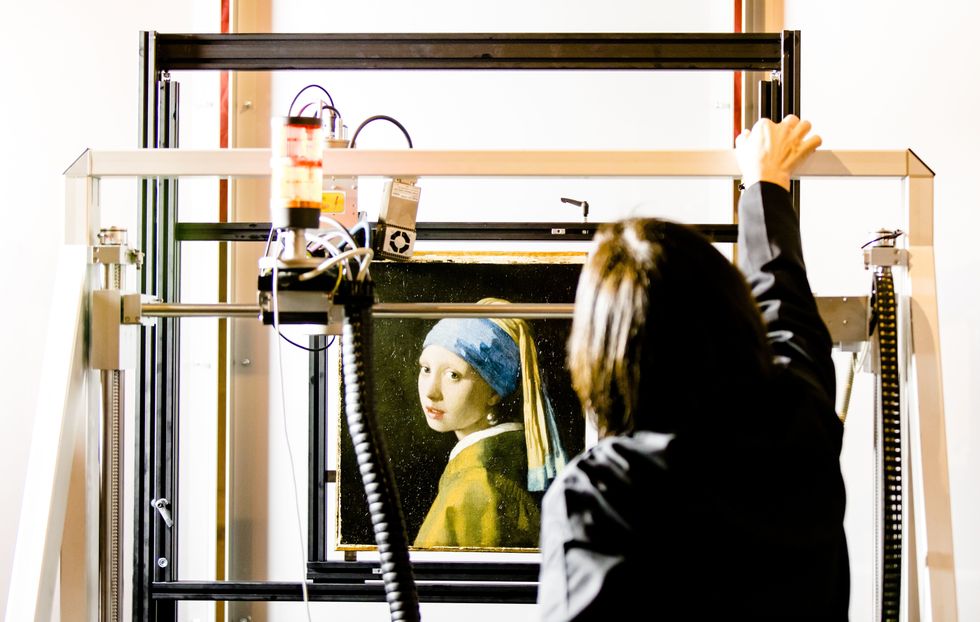 Johannes Vermeer's Girl with a Pearl Earring painting inside a XRF macro-scanner during a research at Het Mauritshuis in The Hague.
BART MAAT/AFP via Getty Images
Johannes Vermeer's Girl with a Pearl Earring painting inside a XRF macro-scanner during a research at Het Mauritshuis in The Hague.
BART MAAT/AFP via Getty Images
Among them are scans that mapped the maze of tiny cracks that have formed in the paint over the years. They will allow the museum to use this research as a baseline to monitor the health of the canvas in coming years.
Analysis of microscopic paint samples pinpointed where the pigments Vermeer used originated.
The white lead that forms the earring comes from the Peak District in northern England, the ultramarine blue is ground from lapis lazuli found in what is now Afghanistan, and the red is cochineal, made from bugs that live on cactus plants in Mexico and South America.
Conservator and project leader Abbie Vandivere said:
“It's surprising how much high-quality ultramarine Vermeer used in the girl's headscarf. This blue pigment was more valuable than gold in the 17th century."
Vermeer did not have to scour the world to get his materials – he most likely bought them in his home town of Delft.
Ms Vandivere added:
"[The findings do not just reveal details about Vermeer's materials] but also tell us about Dutch and world trade in the 17th century."
Research also uncovered the order in which he painted the girl on a woven canvas with a grey base layer.
As if she was looking over Vermeer's shoulder while he was working, research with infrared imaging showed that he began composing the work in shades of brown and black.
He then drew the girl's outline in black lines before working from the green background to the foreground: the skin of her face, her yellow jacket, white collar, blue headscarf and finally the quick dabs of white that make up the pearl. Finally, he signed the top left of the canvas.
Ms Gosselink said:
“The girl has, sadly, not revealed her identity, but we have got to know her better."











 @chefbenqc/Threads
 @the_tre_haus; beckysolwold/Threads
 Ron Jarvis/Facebook
 @kasialove/Bluesky
 Barbara Boetsch/Facebook
 @maupt68/Threads
 @leftofliberal2025/Threads
 @pattistraus/Threads
 @sugarpillseattle/Threads


 @BlueJock/X
 @SentientHaze133/X
 @DivinyPete/X
 @SeanCasten/X
 @IAmJoeTrudeau/X
 @sensiblemiddle/X