
Skip to content
Search AI Powered

Latest Stories

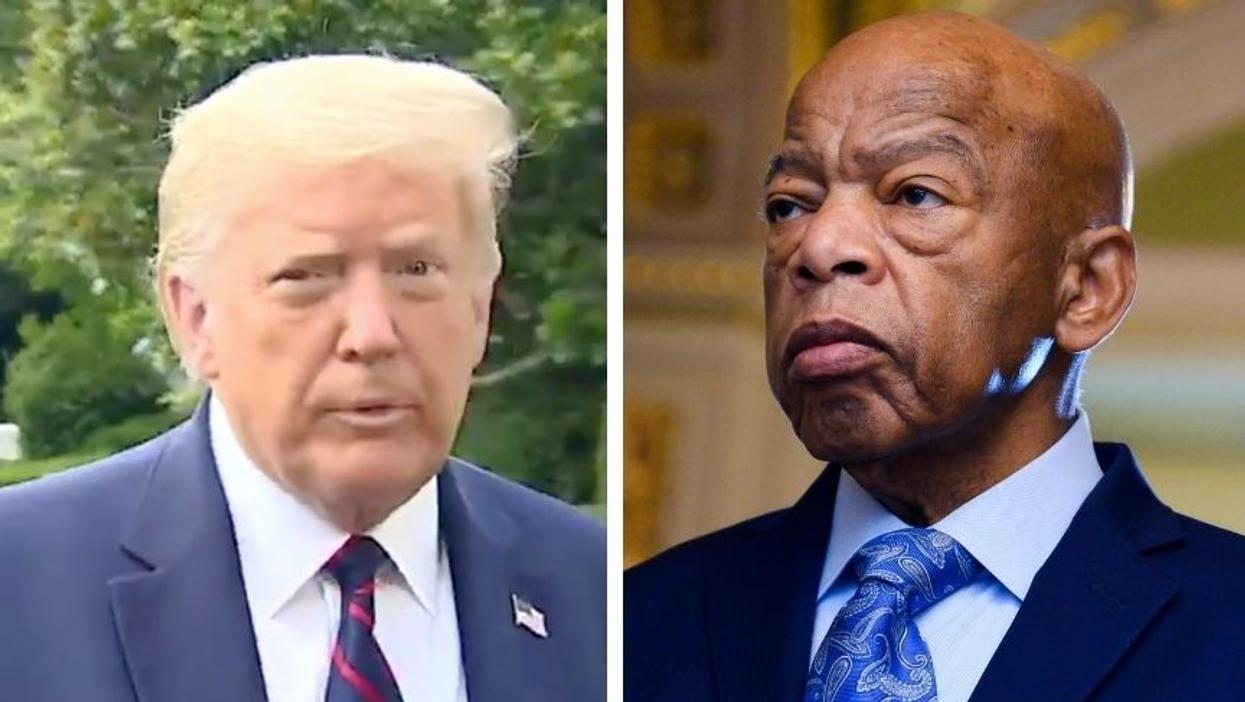
Trump Was Asked If He'd Pay Respects to John Lewis in the Capitol and His Blunt Response Was Peak Trump

Trump Was Asked If He'd Pay Respects to John Lewis in the Capitol and His Blunt Response Was Peak Trump
C-SPAN // Tom Williams
Make us preferred on Google

The United States is mourning the loss of Congressman John Lewis (D-GA), a veteran civil rights icon and activist, who passed away on July 17.

Lewis was a leader in the Student Nonviolence Coordinating Committee during the Civil Rights Movement of the 1960s, where he participated in the Freedom Rides and faced beatings and arrests from southern police officers.


The Congressman's final public appearance was spent in solidarity with protestors in DC's Black Lives Matter plaza, and on Monday, he became the first Black lawmaker to lie in state in the Capitol rotunda—one of the nation's highest honors.

President Donald Trump was asked if he'd be paying respects to Lewis while his body lies in state.

Here's how that went.

Trump said:

"No, I won't be going. No."

The President didn't elaborate on why he wouldn't be going. Though he tweeted condolences for Lewis after news of his death broke and lowered flags to half staff for a day, the two frequently clashed.

Lewis was a vocal critic of Trump and famously boycotted his inauguration in 2017. This prompted Trump to tweet multiple times about Lewis's absence, criticizing the Congressman's district in Atlanta, Georgia and implying that Lewis was passive against violent crimes.

People thought Trump's answer revealed a lot about his character.


Then again, considering Lewis's stance on Trump and his presidency, perhaps Trump staying away was for the better.


With decades of activism and organizing under his belt, Lewis often encouraged young people to "find a way to get in the way" of systems of injustice, and encouraged them to get into what he called "good trouble."

People commemorated his life's work, and urged others to do the same by reinstating a key part of the Civil Rights Act that was struck down in 2013.

Police officers beat Lewis and other Civil Rights protesters in the 1960s for organizing a march in support of the Voting Rights Act. The attacks, which occurred in Selma, Alabama on the Edmund Pettus Bridge, are now remembered as "Bloody Sunday."

Senate Majority Leader Mitch McConnell (R-KY), who commemorated Lewis in the Capitol, is facing added pressure to take up the legislation passed by the House to restore the Voting Rights Act.


The Voting Rights Act restoration bill has now been named in the Congressman's honor.

UPDATE: Former Vice President and 2020 Democratic nominee Joe Biden visited the Capitol with his wife, Dr. Jill Biden, to pay respects to the late Congressman. Vice President Mike Pence is also expected to pay respects in the rotunda.


More from People/donald-trump

The Chicks; Mitch McConnell
Chip Somodevilla/Getty Images; Bill Clark/CQ-Roll Call, Inc via Getty Images

The Chicks Just Cracked A Clever Joke About Mitch McConnell Amid His Ongoing Absence From Congress—And We're Cackling

The Chicks frontwoman Natalie Maines went viral after she made a joke about Kentucky Republican Senator Mitch McConnell amid his continuing absence from Congress due to health issues.

The 84-year-old—who chairs the Senate Rules Committee—was found unconscious at his Washington residence in June, prompting an advanced life support response. Last month, his office said his condition was improving.

Keep ReadingShow less
Screenshot of John Kennedy; Donald Trump
Meet the Press/NBC; Chip Somodevilla/Getty Images

MAGA Senator Shares Theory For Why Trump Constantly Doubles Down On His Claims While Ignoring The Facts—And It's A Big Yikes

During an appearance on Meet the Press, amid another development in the debacle surrounding the Lincoln Memorial Reflecting Pool, Louisiana Republican Senator John Kennedy shared his theory for why President Donald Trump has trouble dropping his conspiracies despite factual evidence to the contrary.

Kennedy's remarks came after the Justice Department conceded that Trump's overhaul of the Reflecting Pool was "hasty and botched" and moved to dismiss the criminal charges against Olympian David Hearn, who had been accused of damaging the site.

Keep ReadingShow less
Screenshot of Robert F. Kennedy Jr.
USA Today

RFK Jr. Was Just Asked What The 'Most Exotic' Food He's Ever Eaten Is—And His Answer So On Brand

Health and Human Services (HHS) Secretary Robert F. Kennedy Jr. had social media users reeling after he declared he doesn't "have a gag reflex" and "will literally eat anything."

Kennedy's interview with USA Today White House correspondent Swapna Venugopal Ramaswamy coincided with the launch of his new YouTube program, The Real Food Show. HHS says the series is designed to provide families with accessible nutrition guidance and budget-friendly cooking advice.

Keep ReadingShow less
Screenshots of Dana Bash and Robert F. Kennedy Jr.
CNN

RFK Jr. Loses His Cool During Heated On-Air Clash With CNN Host Over Vaccines

Health and Human Services (HHS) Secretary Robert F. Kennedy Jr. clashed with CNN anchor Dana Bash on Sunday after she questioned him about his controversial anti-vaccine views.

The possibility of Kennedy assuming any senior government role raised significant concern among public health leaders and federal employees, who argued, even as Kennedy was taking the reins, that he should not have access to the nation's public health infrastructure.

Keep ReadingShow less
Anne Hathaway
Human Rights Campaign/YouTube

Conservatives Are Completely Melting Down Over A 2018 Anne Hathaway Speech About Equality—Because Of Course

In May of 2018, the Human Rights Campaign (HRC)—the largest LGBTQ+ civil rights and political lobbying organization in the United States—awarded actor Anne Hathaway their Ally for Equality Award at their annual dinner.

Actor and rapper Awkwafina introduced Hathaway with a brief career highlight reel followed by Hathaway giving a short acceptance speech where she touched on historic power dynamics, where some hold unearned power and privilege over the minority or marginalized—something HRC works against.

Keep ReadingShow less