

President Donald Trump was criticized after he claimed to reporters this week that officials in his administration suddenly found $30 billion they "never knew existed"—located on what Trump referred to as the "tariff shelf."
Tariffs are a tax on imported goods, usually calculated as a percentage of the purchase price. While tariffs can shield domestic manufacturers by making foreign products more expensive, they are also used as a tool to penalize countries engaged in unfair trade practices, such as government subsidies or dumping goods below market value.
Trump has championed tariffs, arguing falsely that foreign nations bear the cost. In reality, it is American importers—businesses that purchase goods from abroad—who pay the tariffs, with the revenue going directly to the U.S. Treasury.
These companies often offset their increased costs by raising prices for consumers, meaning that tariffs ultimately function as a hidden tax on American shoppers.
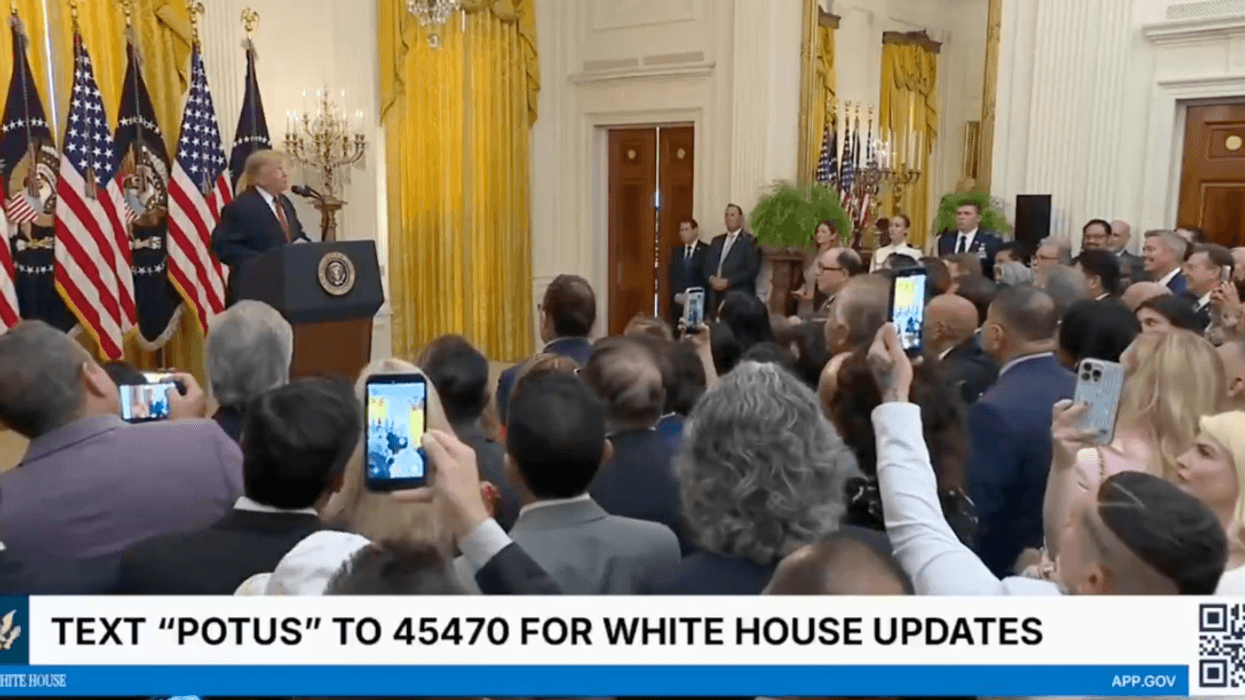
And Trump continues to lie, saying:
“The money coming in, they’re finding money in our country now that they never knew existed. “The other day, $30 billion. Where did it come from?"
"I said, ’Why don’t you check the tariff shelf?’ They said, ’Sir, that tariff hasn’t started yet. It doesn’t start until January.’ I said, ’No, it started two months ago.’ They call back, ’Sir, you’re right. It was from tariffs.’ Now, we have a whole different country.”
You can hear what he said in the video below.
A quick way to tell Trump is lying—his use of the word "sir."
"The word seems to pop into his head more frequently when he is inventing or exaggerating a conversation than when he is faithfully relaying one," CNN's fact-checker Daniel Dale previously observed. "A 'sir' is a flashing red light that he is speaking from his imagination rather than his memory."
These anecdotes almost always center on some triumph Trump casts himself as solely responsible for—such as a supposedly singular tariff victory.
Trump's claim made no sense—and was mocked profusely.
Companies across multiple industries are racing to position themselves for potential refunds as the Supreme Court weighs the future of Trump’s sweeping tariff regime.
In recent weeks, businesses have moved quickly to retain legal counsel, file lawsuits and submit formal claims to the federal government, anticipating a ruling that could unwind billions of dollars in import taxes.
During oral arguments last month, several justices signaled doubt about the president’s expansive interpretation of his authority to impose tariffs unilaterally — a skepticism that has fueled confidence among challengers that the court could strike a major blow to Trump’s economic agenda.
If the court ultimately rules against the administration, it could require the government to return a sizable portion of the roughly $200 billion in duties collected so far this year. Although the justices have not indicated whether refunds would be mandated, many companies are already taking steps to secure their place in line, hoping to recover the full costs of the tariffs they’ve paid.
Costco joined that legal push on Friday, asking a federal trade court to void the tariffs and to “ensure that its right to a complete refund is not jeopardized” while the Supreme Court deliberates.





 @kelsgordon/TikTok
 @kelsgordon/TikTok
 @kelsgordon/TikTok
 @kelsgordon/TikTok
 @kelsgordon/TikTok
 @kelsgordon/TikTok
 @kelsgordon/TikTok
 @kelsgordon/TikTok
 @kelsgordon/TikTok
 @kelsgordon/TikTok
 @kelsgordon/TikTok