
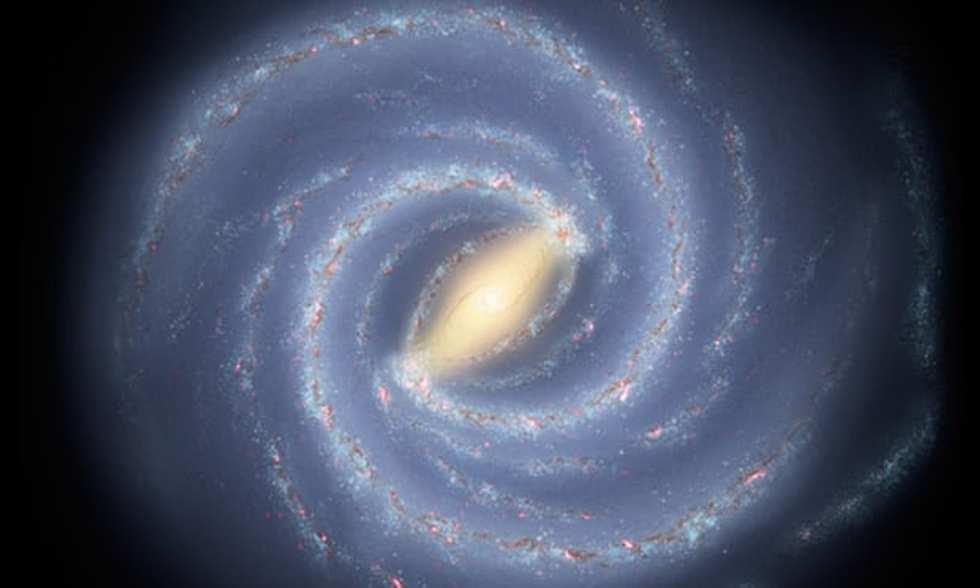

Astronomers led by Dr. Tomoharu Oka at Japan’s Keio University recently discovered an intermediate-mass black hole near the center of our galaxy. The object, called CO-0.40-0.22*, contains 100,000 solar masses and is located 200 light years from the galactic center. Using the Atacama Large Millimeter/Submillimeter Array in Chile, the team measured radio waves emitting from the movement of gas in an interstellar carbon monoxide cloud. Their findings, published in Nature, suggest an intermediate-mass black hole exists inside the cloud. Intermediate-mass black holes form from the collisions of large stars in dense clusters, which merge and then collapse into intermediate-mass black holes. According to Dr. Oka’s report, “large galaxies such as the Milky Way grew to their present form by cannibalizing their smaller neighbors.”
This means black holes at the centers of nearby dwarf galaxies could have collided with other black holes in the Milky Way and were eventually swallowed by the supermassive black hole in our galactic center.
CO-0.40-0.22* is an intriguing clue to solving the mystery of how supermassive black holes form. Despite their prevalence throughout space, the origins of supermassive black holes remain elusive.
“One possible scenario is that intermediate-mass black holes (IMBHs), which are formed by the runaway coalescence of stars in young compact star clusters, merge at the centre of a galaxy to form a SMBH,” Dr. Oka postulated in his study.
Intermediate-mass black holes that form inside star clusters gradually sink to the center of the galaxy, eventually merging with the supermassive black hole at the center. Supermassive black holes contain a million or more solar masses and are typically found at the centers of galaxies. Some of the most distant objects are known as quasars; these active galactic centers contain supermassive black holes that produce jets of charged particles and massive amounts of energy. Quasars contain a billion or more solar masses, and are visible across the observable Universe.
For example, Sagittarius A*, the supermassive black hole at the center of our own Milky Way galaxy, contains four million solar masses. Stars orbiting Sagittarius A* move through space at upwards of eleven million miles per hour, thanks to the black hole’s enormous gravitational field. Incredibly, Sagittarius A* weighs in at 4 million Solar masses, which is relatively small for a supermassive black hole; some contain the mass of BILLIONS of suns. By contrast, the largest supermassive black hole detected by astronomers contains 17 billion solar masses. It lies in the center of galaxy NGC 1277, 250 million light years from Earth.
Stellar mass black holes typically contain between five and ten solar masses and are found commonly throughout the Milky Way. When a star many times larger than our Sun goes supernova, the core collapses under its own gravity into either a neutron star or a black hole. Stellar mass black holes have roughly the same mass as their former stellar selves, compacted into a tiny volume. Gravity inside black holes is infinite. Nothing, not even light, can escape a black hole’s pull. Although they absorb all matter and radiation, a black hole can emit X-rays as it feeds on matter falling through its event horizon, beyond which we cannot see. At the center of black holes lies a singularity, a point of infinite density and gravity. Time and space as we understand them cease to exist, and the known laws of physics are no longer applicable. Thanks to Dr. Oka’s discovery, the mystery of the formation of supermassive black holes may be one step closer to being solved.





 reply to @ginayashere/Instagram
 reply to @team_karim/Instagram
 reply to @ginayashere/Instagram
 reply to @team_karim/Instagram
 reply to @ginayashere/Instagram
 reply to @team_karim/Instagram
 reply to @ginayashere/Instagram
 reply to @team_karim/Instagram
 reply to @team_karim/Instagram