
[DIGEST: NatGeo, AmerRiver, WHO, ScienceAlert, EurekAlert, Science, Forbes, EScience]
In an increasingly dry world, water engineers are looking at a variety of ways to provide essential water. Their work includes desalinization or taking the salt out of sea water to make it useable. However, lakes, rivers, and the smaller ponds and streams make up only two percent of Earth's water resources, and only one percent remains drinkable.
The Apalachicola-Chattahoochee-Flint Basin in Alabama, Georgia, and Florida tops a 2016 list as the most endangered river in the U.S. The second most endangered is the San Joaquin River in northern and central California. Water wars are breaking out.
"Both rivers suffer from increasing conflict among stakeholders who depend on their water," including cities, farmers and wildlife, says Chris Williams, a senior vice president at American Rivers. "And these issues are exacerbated by population growth and climate change."
Two-thirds of the world's population is currently experiencing a shortage of clean water. The World Health Organization estimates that a single person needs to consume two to three quarts of water per day to survive. When you take into consideration long-term survival and the need for water for drinking, cooking, personal and clothes washing, sanitation and waste disposal, food production, crops, livestock and gardens, that number rises to 15 to 20 gallons a day.
But what if you didn’t need water to get water?
Pulling water out of thin air
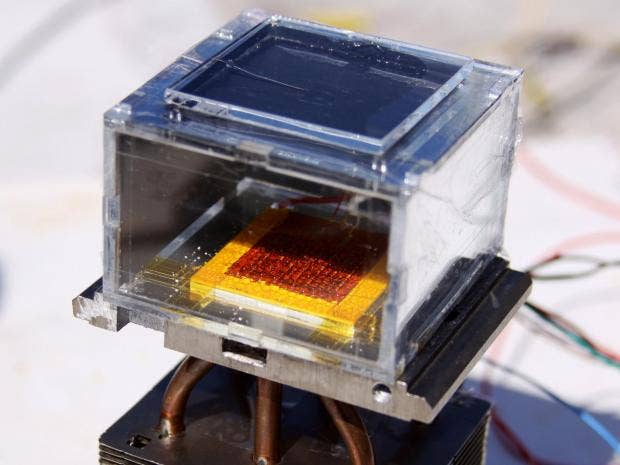
A new device that pulls fresh water out of thin air, even in places with humidity as low as 20 percent is in the prototype stage right now. And all it needs is sunlight. Called the solar-powered harvester, the device was created by teams from MIT and the University of California, Berkeley, using a special type of material known as a metal-organic framework (MOF). Results published in Science consider the solar device a major breakthrough in harvesting water from the air in arid desert conditions.
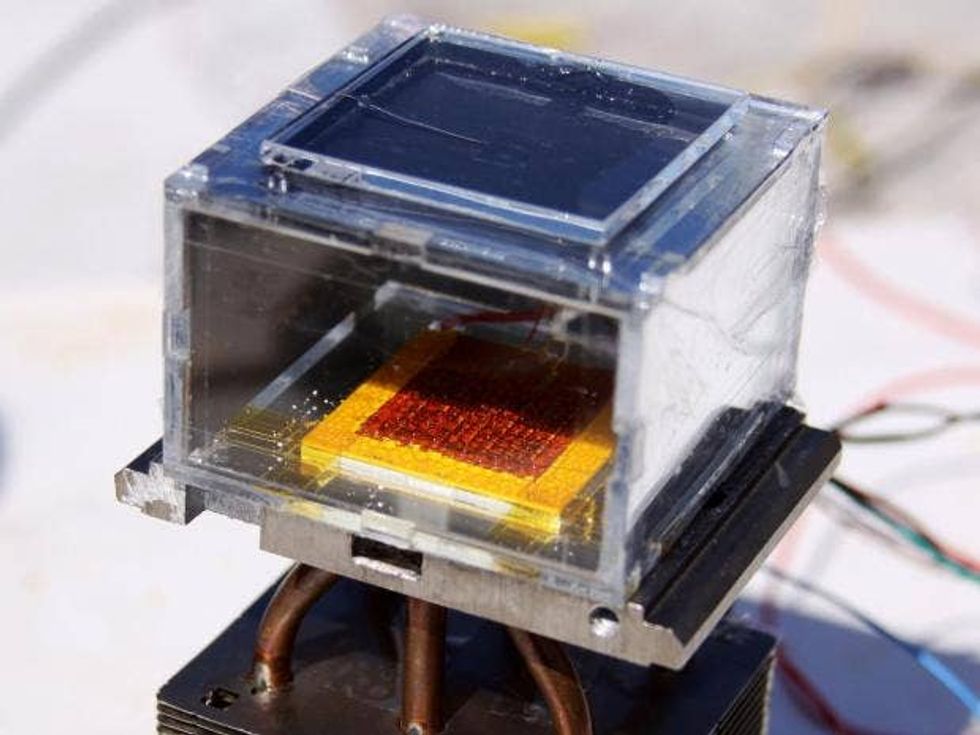 Credit: Source.
One of the researchers, Omar Yaghi from UC Berkeley explained, "There is no other way to do that right now, except by using extra energy. Your electric dehumidifier at home produces very expensive water."
Scientists estimate that there's about 13,000 trillion liters of water worldwide present in the air all around us. Harvesting all that water on a planet with seven billion people would mean 1857 liters per person. If you used 20 gallons a day it would last about six months.
Technologies borrowed from nature
New technologies and biomimicry make water collection and purification easy, dependable and affordable. Biomimicry consists of watching nature very closely; for example, looking at how a camel, beetle or tree survives in a desert. Each has evolved ways to use a minimal amount of water or ways to create water to survive. Nature has already solved many of the problems we are facing. Humans are starting to mimic these innovative processes.
One approach learned from trees is called fog harvesting. Even in areas without considerable rainfall, at certain times of the day the air contains enough moisture to be captured and stored. Fog collection refers to the collection of water from fog using large pieces of vertical canvas to make the fog condense into droplets of water and flow down towards a trough below the canvas. It requires no external energy source to perform its collection.
The Stenocara beetle lives in the extreme conditions of the Namib desert in Southern Africa. The beetle collect dew on its backs and not just fog as previously thought. This is made possible by the wax nanostructure on the surface of the beetle’s elytra or shell. These findings are improving the water yield of manmade dew condensers that mimic the nanostructure on the beetle’s back.
These new nature-inspired technologies may help us avoid a waterless future, as Frank Herbert describes in his science fiction classic Dune. In Herbert's desert world of Arrakis, water became a form of currency with communities battling over its control and flow.












 @lpeterp/Bluesky
 @FPWellman/X
 @bobsbeatgmail.com5/Threads