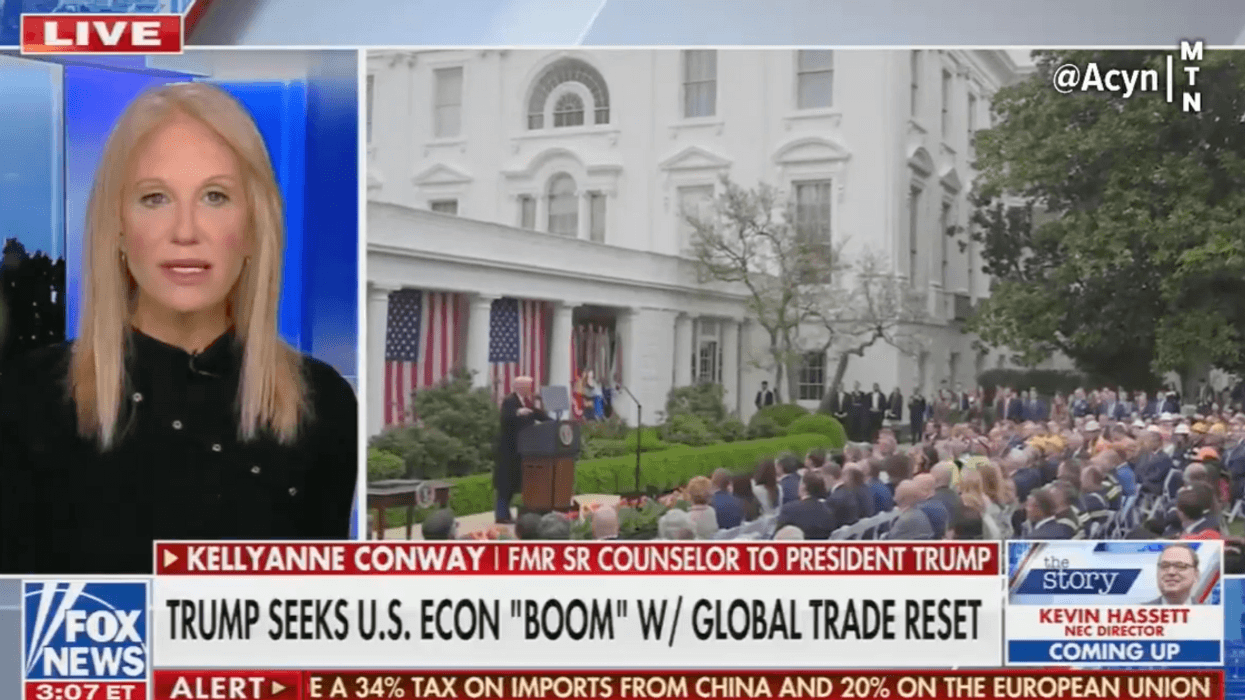

President Donald Trump's former White House counselor Kellyanne Conway was criticized after she tried to put a positive spin on Trump's tariffs after they immediately had a negative impact on the stock market, erroneously rebranding them as "sanctions."
Trump, in his tariff announcement on Wednesday, declared April 2 as the day American industry "will be reborn," heralding what he called a "golden age of America." He emphasized that the new tariffs would not only counter foreign tariffs but also address what he described as "nonmonetary" trade barriers, including currency manipulation and "pollution havens."
Among other things, he warned foreign countries that "if you want your tariff rate to be zero, then you build your product right here in America.”
He outlined steep tariff rates, with China set to face a 34 percent tariff, the European Union 20 percent, Japan 24 percent, and India 26 percent. On top of these, he announced a universal baseline tariff of 10 percent, meaning that some countries, like China, could effectively face a 44 percent tariff when combined with existing duties. His move sent the markets tumbling, with the Dow down 1600 points on Thursday.
Conway remarked on Fox News:
“For everybody saying tariffs are a tax, I think you have to look at them more as the old sanctions. The president is attempting to empower and incentivize transformative and generational changes in behavior by companies, by categories, by collections of countries."
"EU, I'm looking at you."
You can hear what she said in the video below.
There are so many problems with Conway's statement.
Tariffs are a tax on imported goods, usually calculated as a percentage of the purchase price. While tariffs can shield domestic manufacturers by making foreign products more expensive, they are also used as a tool to penalize countries engaged in unfair trade practices, such as government subsidies or dumping goods below market value.
Trump has championed tariffs, arguing falsely that foreign nations bear the cost. In reality, it is American importers—businesses that purchase goods from abroad—who pay the tariffs, with the revenue going directly to the U.S. Treasury.
These companies often offset their increased costs by raising prices for consumers, meaning that tariffs ultimately function as a hidden tax on American shoppers.
Economic sanctions are measures that restrict trade and financial dealings to achieve foreign or security policy objectives. These can be broad, such as the longstanding U.S. embargo on Cuba, which halts nearly all commercial engagement with a country, or more targeted, focusing on specific individuals, companies, or organizations.
Governments and international organizations like the United Nations and the European Union use sanctions as tools to pressure or penalize actors that threaten global stability or breach international norms. They’ve been employed to support a wide range of policy aims, from combating terrorism and drug trafficking to promoting human rights, nonproliferation, democracy, conflict resolution, and cybersecurity.
While they are a form of intervention, sanctions are often considered a middle-ground approach—less costly and risky than military action, but more assertive than diplomacy alone.
It was clear Conway was attempting to change the narrative—and she was swiftly criticized for it.
Conway has long carried water for Trump despite a strained relationship.
After Conway served as Trump's campaign manager, Trump appointed Conway as Counselor to the President shortly after winning the 2016 general election, referring to her in a statement as "a trusted adviser and strategist who played a crucial role in my victory."
Conway ultimately fell out with Trump when he lashed out at her after she revealed in her memoir that she personally told him he lost the 2020 presidential election to then-candidate Joe Biden, undermining his false claims of massive voter fraud.
But she is most remembered for remarks she made early in the first Trump administration—Conway gained notoriety for claiming White House Press Secretary Sean Spicer "gave alternative facts" while lying about the attendance numbers at Trump’s inauguration.
Saying "sanctions" as opposed to "tariffs" is just a sign she's sticking to the same playbook.


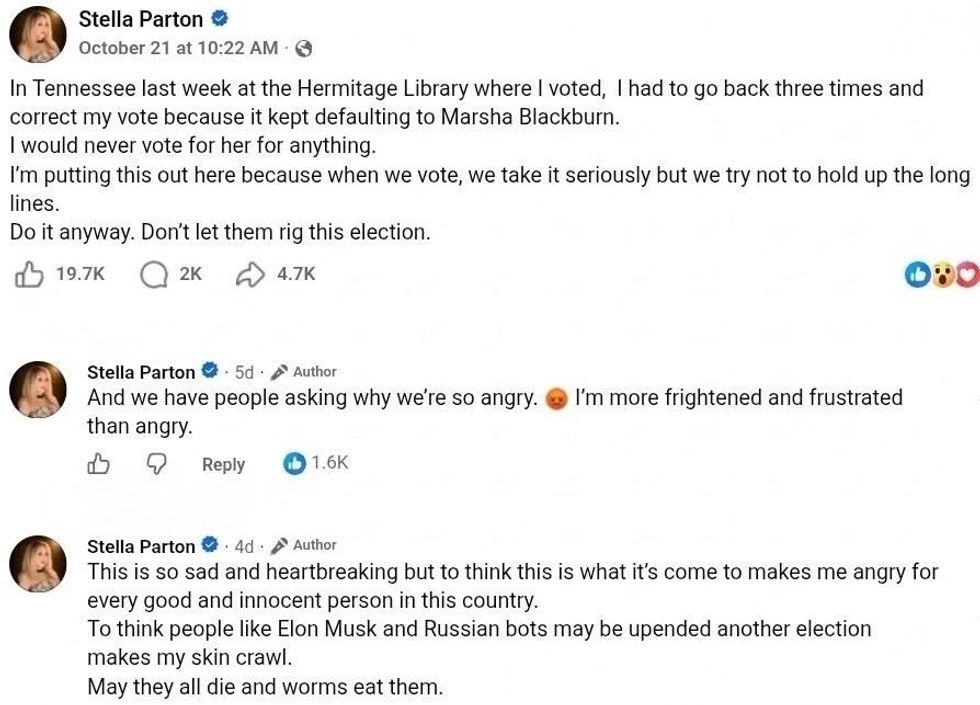 Stella Parton/Facebook
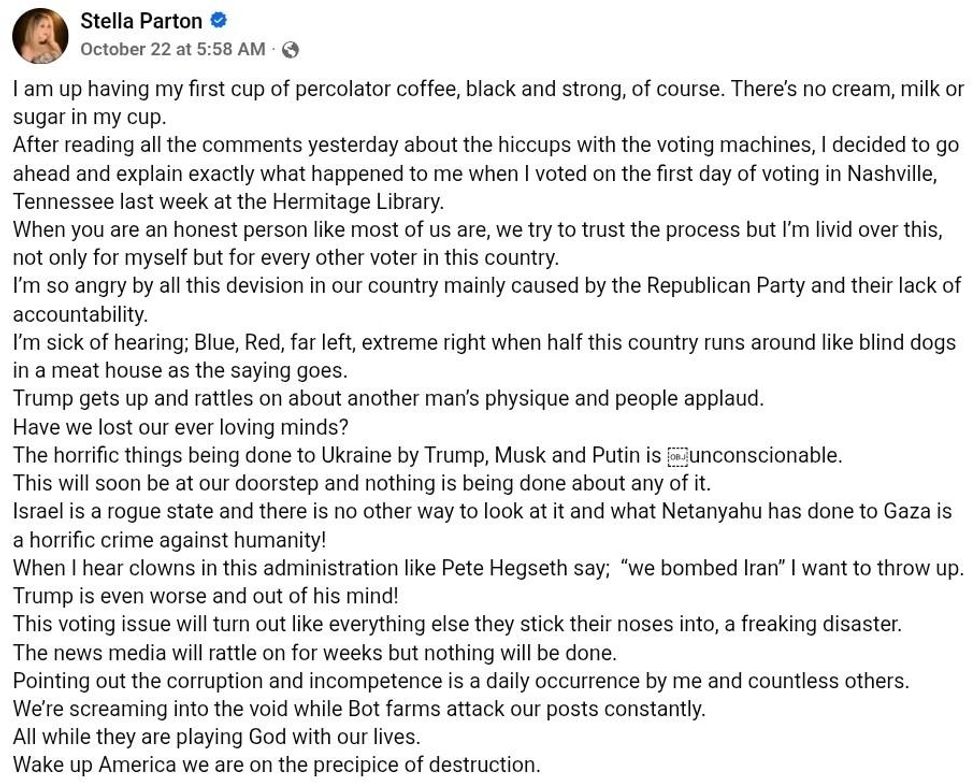 Stella Parton/Facebook
 reply to Stella Parton/Facebook
 reply to Stella Parton/Facebook
 reply to Stella Parton/Facebook
 reply to Stella Parton/Facebook
 reply to Stella Parton/Facebook
 reply to Stella Parton/Facebook
 reply to Stella Parton/Facebook
 reply to Stella Parton/Facebook
 reply to Stella Parton/Facebook
 reply to Stella Parton/Facebook
 reply to Stella Parton/Facebook
 reply to Stella Parton/Facebook
 reply to Stella Parton/Facebook
 Atlanta Falcons (@AtlantaFalcons) on