

[DIGEST: IFLS, NASA, Space, Jung, Science]
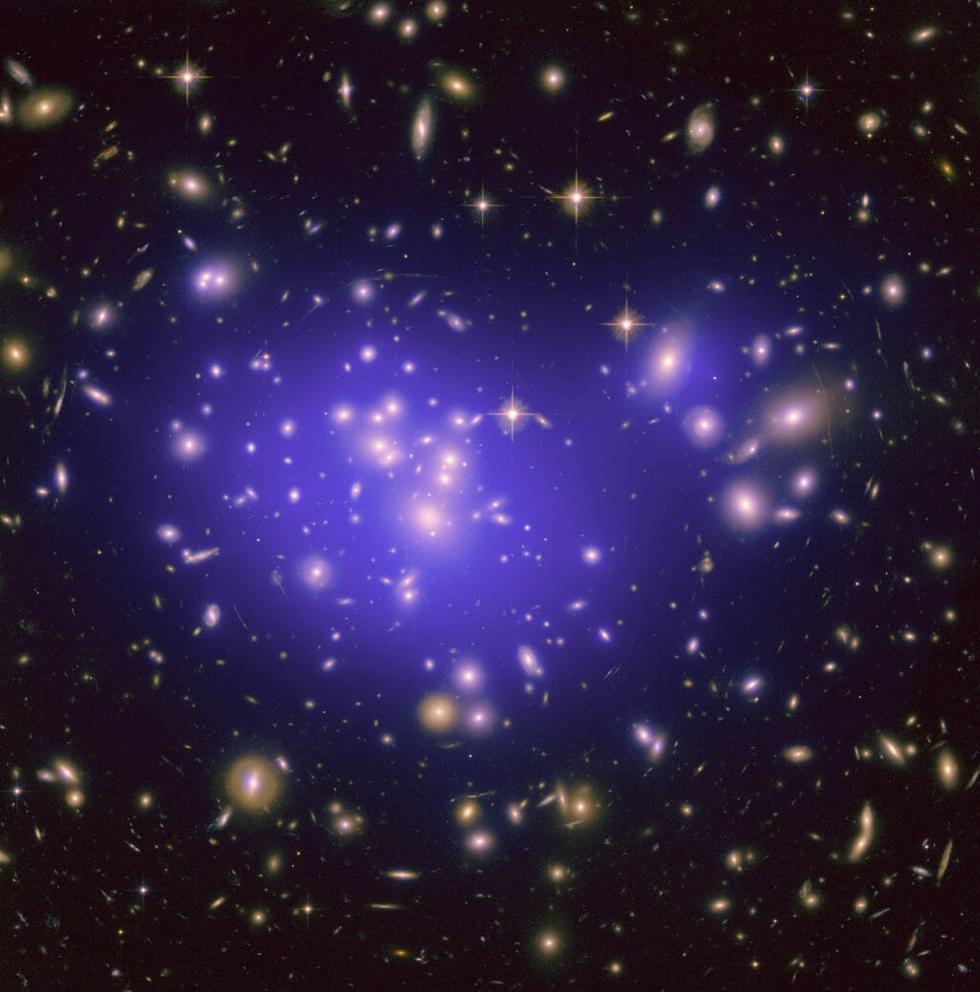
Dark energy–the prevailing theory that explains the forces in the universe–may not actually exist. A new paper published in Monthly Notices of the Royal Astronomical Society in February suggests that a unified theory of the universe doesn’t require dark energy, once unique pockets of energy in the universe are factored into the equation.
Theoretical physicists introduced dark energy 20 years ago to explain observed phenomena like the universe expanding at an accelerated rate. No one has ever observed dark energy. It is an abstract concept plugged into a complex mathematical formula to explain the forces in the universe. In the formula dark energy exerts a force on the universe and is thought to make up 68 percent of the energy in the universe.
Einstein's famous equation, E = MC2, teaches us that matter and energy are interchangeable. Matter and energy are different forms of the same thing. The sun, for example, is powered by the conversion of mass or matter into energy.
Light waves radiate energy and act on matter (as anyone who has been sunburned knows). That sunburn is caused by sun-matter being converted into light or radiation energy. The light waves travel 150 million kilometers to the surface of the skin—burning it with the intensity of the energy.
In the case of the sun, the source of the matter that converts into energy is clear. With dark matter, the source is less obvious. Physicists continue to search for ways to explain both dark matter and what they observe in the universe.
The recent study, led by researchers at the Eötvös Loránd University in Hungary, suggests that matching precise astronomical observations with the approximated theories of the universe might have created the need for dark energy in the equation.
A hundred years ago, in keeping with physicists’ thinking at the time, Albert Einstein inserted a term called the cosmological constant into his theory of general relativity to force the equations to predict a stationary universe. When it became clear that the universe was expanding, Einstein abandoned the constant, calling it the biggest blunder of his life. But
20 years ago scientists revived Einstein's cosmological constant to explain a mysterious force called dark energy that seems to be counteracting gravity causing the universe to expand at an accelerating pace. They might still be blundering.
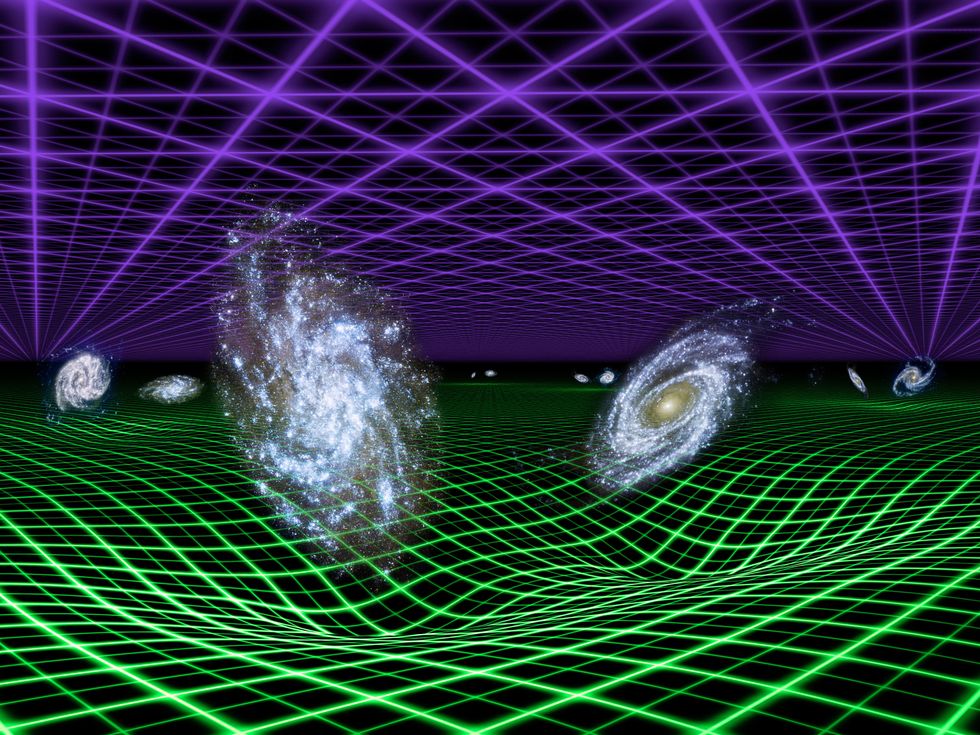
In the Hungarian study, researchers explained that different regions in the universe expand at different rates depending on how matter is distributed while the cosmos retains an average accelerated expansion.
"Einstein’s equations of general relativity that describe the expansion of the universe are so complex mathematically, that for a hundred years no solutions accounting for the effect of cosmic structures have been found,” co-author Dr László Dobos.
Dobos' study is based on applying the data from individual areas of the universe that are expanding at different rates rather than applying a statistical average rate of expansion. Taking into account these individual differences no longer requires dark energy to make the equation work.
 Credit: Source
Perhaps the "average" universe doesn't exist. Psychologist Carl Jung might have been describing models of the universe when he said, “Any theory based on experience is necessarily statistical. This [statistical average] is quite valid though it need not necessarily occur in reality. This is particularly true of theories which are based on statistics. The distinctive thing about real facts is their individuality. Absolute reality has predominantly the character of irregularity." Giving an example, he said, "I determine the weight of each stone in a bed of pebbles and get an average weight of 145 grams, this tells me very little about the real nature of the pebbles. Anyone who thought, on the basis of these findings, that he could pick up a pebble of 145 grams at the first try would be in for a serious disappointment."
Taking the irregularity into account, Gábor Rácz and László Dobos simulated cubes of space measuring 480 million light-years along each side. Instead of using the more common Friedmann-Lemaître-Robertson-Walker (FLRW) metric to calculate a single scale factor for the entire cube, they broke the cube into one million mini-universes and then used the equation to calculate the scale factor in each of them. “We assume that every region of the universe determines its expansion rate itself,” Dobos says. The researchers then calculated the average of the many scale factors. The number they reached was different from the scale factor calculated from the universe's average density.
The results suggest that it may be possible to explain away dark energy as an illusion. Others are more cautious. Tom Giblin, a computational cosmologist at Kenyon College in Gambier, Ohio, who has worked on a similar analysis, says, “I would love if inhomogeneities explained dark energy.” However, he says, “I don’t see any evidence from our simulations to expect it to be as big an effect as they see here.”










 @MuffinsNsuch/X
 @serena_loscalzo/TikTok
 @serena_loscalzo/TikTok
 @serena_loscalzo/TikTok
 @serena_loscalzo/TikTok
 @serena_loscalzo/TikTok
 @serena_loscalzo/TikTok
 @serena_loscalzo/TikTok
 @serena_loscalzo/TikTok
 @serena_loscalzo/TikTok
 @serena_loscalzo/TikTok
 @itsvictoriavega/TikTok
 @itsvictoriavega/TikTok
 @itsvictoriavega/TikTok
 @itsvictoriavega/TikTok
 @itsvictoriavega/TikTok
 @itsvictoriavega/TikTok
 @itsvictoriavega/TikTok
 @itsvictoriavega/TikTok
 @itsvictoriavega/TikTok
 @itsvictoriavega/TikTok
 @lolxdlolxdlolxd23455/TikTok
 @lolxdlolxdlolxd23455/TikTok
 @lolxdlolxdlolxd23455/TikTok
 @lolxdlolxdlolxd23455/TikTok
 @lolxdlolxdlolxd23455/TikTok
 @lolxdlolxdlolxd23455/TikTok
 @lolxdlolxdlolxd23455/TikTok
 @lolxdlolxdlolxd23455/TikTok
 @lolxdlolxdlolxd23455/TikTok
 @lolxdlolxdlolxd23455/TikTok
Larry David's New Satirical Essay Mocking Democratic Socialists Isn't Sitting Well With People