

[DIGEST: Guardian, PBS, Discover, Washington Post, Mashable]
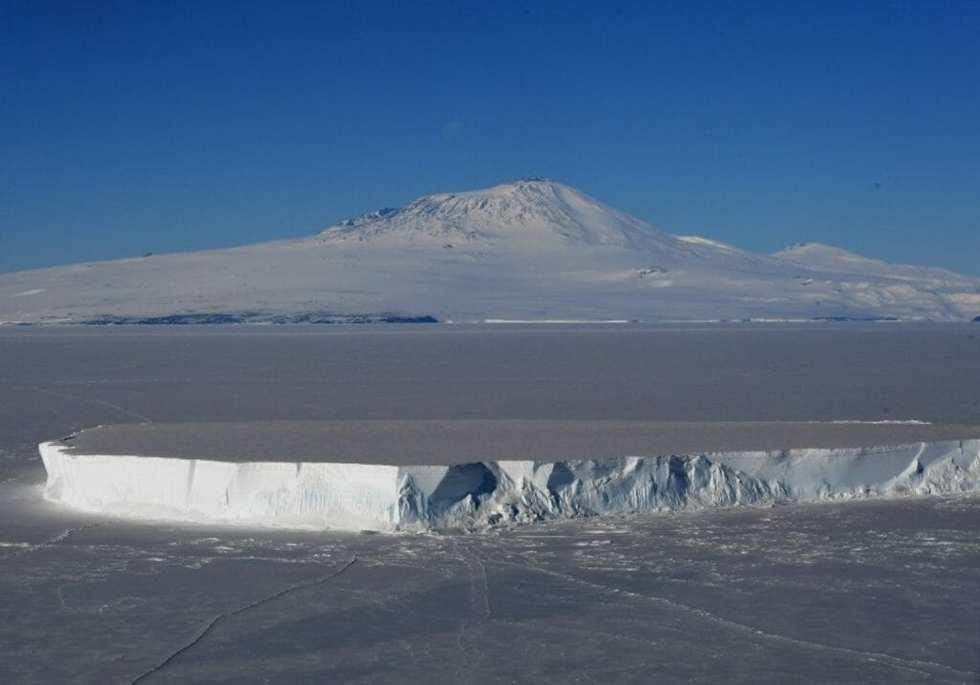
An undergraduate student obsessed with volcanoes wanted to explore beyond the tips visible through the West Antarctic’s giant ice sheet to see how many more were hidden underneath. The resulting study may have uncovered the largest area of volcanoes on the planet. Scientists are watching closely to determine what effect nearly 100 volcanoes sitting under Antarctica could have on climate change.
Discovery of Volcanoes
Max Van Wyk de Vries, a third-year student in the School of Geosciences at the University of Edinburgh, conceived the project after reviewing Antarctica’s public radar mapping data for a class during his freshman year.
“I started discovering these cones,” De Vries said. After growing up in an area of France dotted with volcanoes, he recognized the shape. “I realized that maybe there was something special going on.”
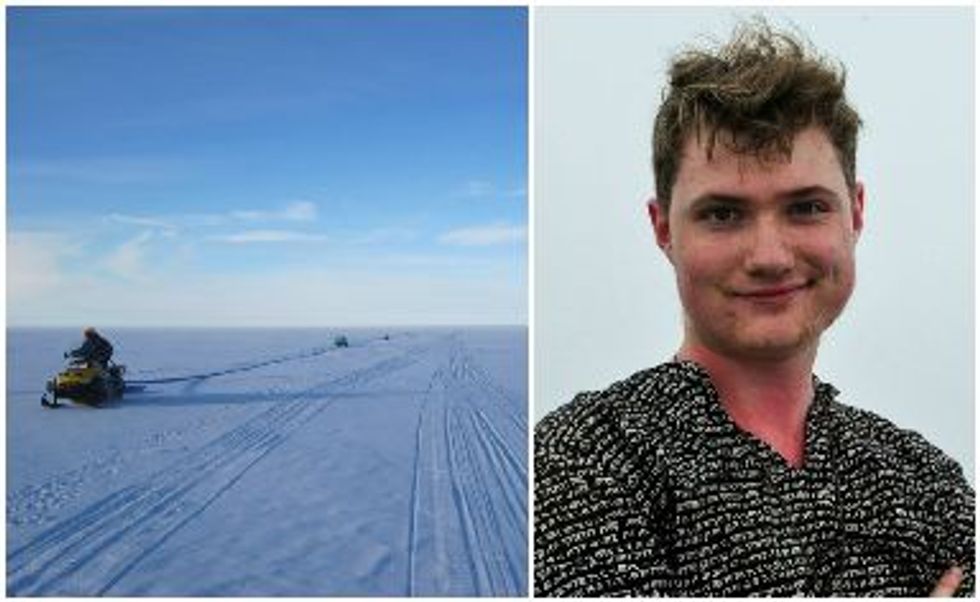 Max Van Wyk de Vries. (Credit: R.G. Bingham)
He enlisted the help of professor Robert Bingham to organize the study, in which researchers conducted remote surveys of the ice sheet’s underside seeking concealed crests of basalt rock—similar to the nearby volcanoes where the tips push through the ice. Scientists also used ice-penetrating radar, satellite and database records, and aerial surveys to compare and analyze the land’s shape underneath the ice.
“Essentially, we were looking for evidence of volcanic cones sticking up into the ice,” Bingham said.
The results shocked even the researchers, who found 91 previously undiscovered volcanoes, for a total of 138 in the region.
“We were amazed,” Bingham said. “We had not expected to find anything like that number. We have almost trebled [sic] the number of volcanoes known to exist in West Antarctica.”
They range in height from 100 to 3,850 meters and are located in an area known as the West Antarctic Rift System, which covers 3,500 kilometers. Experts say the newly discovered volcanic range contains many similarities to East Africa’s volcanic ridge, currently recognized as the densest concentration of volcanoes on Earth.
But Bingham speculates the West Antarctic Rift System will overtake that record. “We … suspect there are even more on the bed of the sea that lies under the Ross ice shelf, so that I think it is very likely this region will turn out to be the densest region of volcanoes in the world, greater even than east Africa, where mounts Nyiragongo, Kilimanjaro, Longonot and all the other active volcanoes are concentrated.”
While the study does not determine whether the volcanoes are active, it does address the need to learn more in this area.
The study authors write, “Improving our understanding of subglacial volcanic activity across the province is important … in light of concerns over whether enhanced geothermal heat fluxes and subglacial melting may contribute to instability of the West Antarctic Ice Sheet.”
Are Volcanoes Hastening Glacial Melting?
Some scientists are already expressing direct concern over the effect of the volcanoes on climate change.
For instance, Bingham said, “If one of these volcanoes were to erupt it could further destabilise west Antarctica’s ice sheets.” He added, “Anything that causes the melting of ice – which an eruption certainly would – is likely to speed up the flow of ice into the sea.”
Studies conducted in Iceland show that as glaciers melt, seismic activity increases. Taken together with the number of volcanoes in the West Antarctic Rift System, these indicate that seismic activity was likely during previous warm periods. Scientists are attempting to tease out cause and effect.
As de Vries explains, “By themselves the volcanoes wouldn't be likely to cause the entire ice sheet to melt.” However, if global warming is melting the glacier, he predicts a different result. He explains, “[i]f we start reducing significant quantities of ice … you can more or less say that it triggers an eruption.”
One volcanic eruption could destabilize more of the region’s ice sheets, already weakened by global warming, creating a cyclical effect that extends to rising sea levels elsewhere.
In support of this theory, Bingham said, “The most volcanism that is going in the world at present is in regions that have only recently lost their glacier covering – after the end of the last ice age. These places include Iceland and Alaska.” He explains, “Theory suggests that this is occurring because, without ice sheets on top of them, there is a release of pressure on the regions’ volcanoes and they become more active.” In West Africa, he says, “It is something we will have to watch closely.”
Or Are the Volcanoes Preserving the Glacier?
On the other hand, the volcanoes have been underneath the Antarctic for quite some time. While they are relatively young, according to de Vries, they were born an estimated few million years ago.
Scientists offer a possible explanation for the ongoing presence of the volcanoes and the glaciers. The volcanoes create uneven terrain, which stops the ice from flowing smoothly.
“Models have shown that the rate of ice sheet retreat strongly depends on the shape and roughness of the surface beneath the ice. If the rock bed of the ice sheet is smooth, then retreat can proceed rapidly, but if the bed contains lots of topography, like volcanic cones, or craters, then this could slow the rate of retreat a lot,” according to John Cottle, a geology professor at the University of California, Santa Barbara.
In fact, the de Vries study posits that the projections of the volcanoes may act to “pin” sections of the ice sheet in place, effectively slowing its collapse.
"Numerical models used to project potential rates of WAIS [West Antarctic Ice Sheet] retreat show that, once initiated, ice retreat will continue unabated as long as the ice bed is smooth and downslopes inland, but that any increase in roughness or obstacle in the bed can act to delay or stem retreat," the study stated.
Study authors explained, "We have identified here a number of volcanic edifices sitting within the [West Antarctic Ice Sheet's] deep basins; these edifices, which are likely to owe their existence to volcanism, could represent some of the most influential pinning points for past and future ice retreat."
Continuing research and further observation of the West Antarctic Ice Sheet and its Rift System will uncover more about its environmental effects.
Meanwhile, as Bingham said, “It is fascinating to uncover an extensive range of volcanoes in this relatively unexplored continent. A better understanding of volcanic activity could shed light on their impact on Antarctica’s ice in the past, present, and future, and on other rift systems around the world.”





 Brendan Smialowski/AFP via Getty Images
 Brendan Smialowski/AFP via Getty Images
 Brendan Smialowski/AFP via Getty Images





 @hannahhrevels/TikTok
 @hannahhrevels/TikTok
 @hannahhrevels/TikTok
 @hannahhrevels/TikTok
 @hannahhrevels/TikTok
 @hannahhrevels/TikTok
 @hannahhrevels/TikTok
 @hannahhrevels/TikTok
 @hannahhrevels/TikTok
 @hannahhrevels/TikTok
 @hannahhrevels/TikTok
 @hannahhrevels/TikTok
 @Raye455/X
 @JoJoFromJerz/X
 @phlynnmartin/TikTok
 @phlynnmartin/TikTok
 @phlynnmartin/TikTok
 @phlynnmartin/TikTok
 @phlynnmartin/TikTok
 @phlynnmartin/TikTok
 @phlynnmartin/TikTok
 @phlynnmartin/TikTok
 @phlynnmartin/TikTok
 @phlynnmartin/TikTok
 @phlynnmartin/TikTok
 @sailors.mama/TikTok
 @sailors.mama/TikTok
 @sailors.mama/TikTok
 @sailors.mama/TikTok
 @sailors.mama/TikTok
 @sailors.mama/TikTok
 @sailors.mama/TikTok
 @sailors.mama/TikTok
 @sailors.mama/TikTok
 @sailors.mama/TikTok
 @sailors.mama/TikTok
 @sailors.mama/TikTok