

We cannot escape our plastic problem. Every day, we eat food and buy products that contain or have been packaged in plastic. Now we are starting to learn how that plastic never really leaves us. The first major study of microscopic plastic in drinking water has found widespread contamination of drinking water in cities around the world. With every glass of water we drink, we consume plastic.
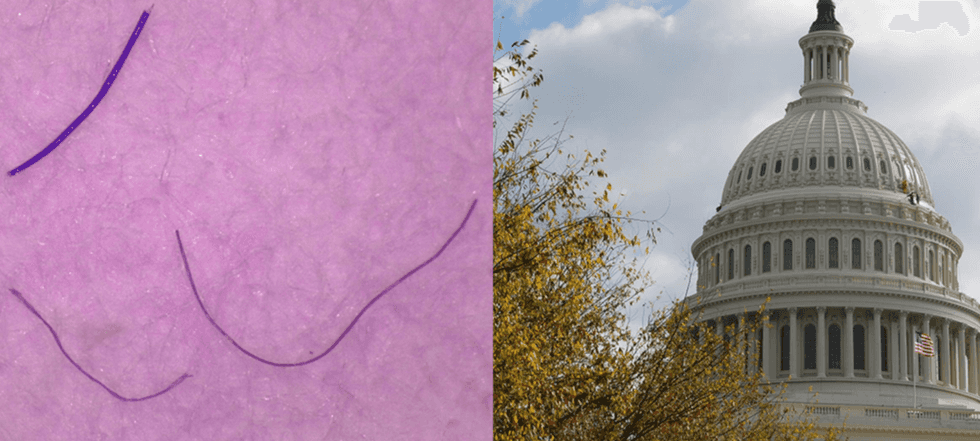
Orb Media and a researcher at the University of Minnesota School of Public Health tested drinking water from the taps in major cities on five continents, and found that more than 83 percent — 94 percent in the US — contained microscopic particles of plastic. These particles come from the everyday abrasive wear on carpets, furniture, tires, paints and clothing, as well as from microbeads and the partial degradation of other plastic materials.
A large source of plastic microfibers is our plastic-based clothing. A single garment can shed thousands of plastic fibers in a single wash. Moving through the wastewater treatment system and into the environment, these fibers are accumulating in every body of water, and have been found at the deepest levels of the ocean. Since these tiny particles exist in our water, they are now infiltrating our food sources. The sheer volume of plastic in the environment means that it is accumulating in the bodies of the fish, wildlife, and livestock we eat, as well as in our drinking water. That means it’s in humans too.
No government has established a “safe threshold” for the amount of plastic fibers humans can ingest, but we are already seeing the effects of plastic on wildlife. Scientists are finding that plastic fibers are “weaving themselves into the gastrointestinal tract” of Great Lakes Fish. Plastics give off hormone-disrupting chemicals that have been associated with cancer, birth defects, learning disorders, feminization in male invertebrates — and possibly declining human male fertility.
“Endocrine disrupting chemicals that are omnipresent, such as bisphenol A, are one of the defining human health challenges of our times,” said Natacha Cingotti, a spokeswoman for Europe’s Health and Environment Alliance.
Plastic never entirely breaks down. Every piece of plastic ever made still exists, at least in small parts. Even the plastic that does break down degrades into particles on the nanometer scale — but tiny doesn’t mean harmless. In fact, these tiny plastic particles — as small as one-one thousandth of one-one thousandth of a millimeter — can permeate the intestinal wall and migrate through the body to the lymph nodes and other organs. The 10-month study found an average number of 4.8 plastic fibers per 500 ml (16 ounces) of water. In Germany, chemists found plastic fragments in 24 types of beers.
It’s also in our air. A 2016 study in France found that three to ten tons of microfibers rain out of the air onto the 1,098-square-mile region surrounding Paris each year.
“This should knock us into our senses. We knew that this plastic is coming back to us through our food chain,” tweeted Muhammad Yunus, Nobel Peace Prize laureate and founder of Grameen Bank. “Now we see it is coming back to us through our drinking water. Do we have a way out?”
Consumers can limit their amount of plastic exposure to by using glass, metal or silicone food storage containers; refusing straws; and opting for clothing made from natural materials to limit the amount of microfibers they release into the waterways. Some companies are also looking for solutions.
“This is frightening information. It’s time for all of us to wake up,” said Dianna Cohen, co-founder of the Plastic Pollution Coalition. “Microfibers are insidious. If we’re finding them in everything around us, the obvious solution is to go to the source, to refocus our energy, and to move away from toxic plastics.”
Most of the plastic microfibers originated with clothing, but the fashion industry has done little to address the problem. One exception: Patagonia, a company known for its sustainable business practices, helped fund a study that explored the impact of the apparel industry on microfiber plastic pollution. The company acknowledges that its fleece products contribute to the problem, and now provides customers education about how to wash synthetic clothing to minimize the release of plastic fibers. (Hint: Wash things less often, use a front-loading washer, and choose high-quality items that shed less.) The company is also studying alternate materials in search of a safer alternative. One possibility? Silk made by spiders.
Entrepreneurs are hoping consumers will try to reduce their contribution to the plastics released in washing machine wastewater. The Cora Ball is a device that collects plastic microfibers when added to a load of laundry. The Guppy Friend is a special washing bag that captures microfibers from fleece and synthetic clothing. People can also attach special filters to their washing machine’s discharge hose. The Surfrider Foundation, which focuses on ocean pollution, is also urging wastewater plants to upgrade filtration systems and has called on the washing machine industry to add filters to the units.
“We hope that countries and organizations look into this very seriously,” said Orb study author Chris Tyree. “Every day we create huge amounts of plastic waste, which we are dumping on the next generations. The longer we wait before taking measures and implementing solutions, the more harmful the effects will be.”
With no political imperative to tackle the problem, the environment remains at the mercy of individual consumer actions. “The fact that we’re finding microfibers in bottled water and tap water is a wake up call,” said Cohen. “On an individual level, if you have the ability to filter your drinking water, please do. On a larger scale, demand that your local water municipality improve their filtration systems to address microfibers immediately. Fashion industry, hear us: If you are making clothing out of synthetics, you are part of the problem.”











 @Rob Schneider/X
 @Rob Schneider/X
 @pancho_runs/Instagram
 @risheeee/Instagram
 @nickwetzel10/Instagram
 @bailey_marie1212/Instagram
 @atrain29730/Instagram
 Soldier for Life/Facebook