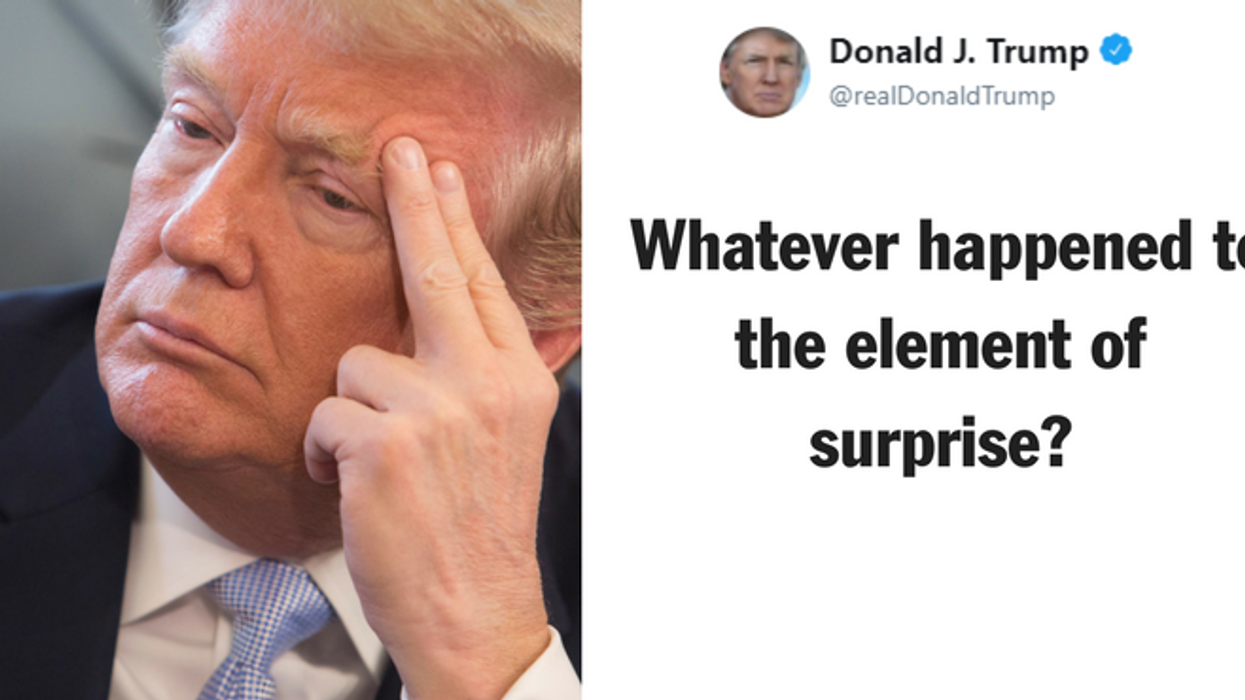

President Donald Trump's tweets about President Obama's handling of ISIS and Syria are coming back to haunt him.
As Trump mulls his options over how to respond to Saturday's chemical weapon attack in Ghouta, Syria, his proposed threats of missile strikes are exactly what he said Obama shouldn't do. In a single tweet early Wednesday morning, Trump threatened to hit Syria with "nice and new and 'Smart!!'" missiles while simultaneously goading Russia, who threatened to shoot down any American missiles and hit back at their points of origin.
On Saturday, more than 40 people were killed and hundreds more injured when poison gas was released in Ghouta, a suburb east of Damascus. Syrian officials have denied involvement in the attack, and have invited the United Nation's investigative team to look into the incident. Iran and Russia, both of whom are allies of the war-torn country, called allegations of Syrian involvement "ridiculous."
"Russia vows to shoot down any and all missiles fired at Syria. Get ready Russia, because they will be coming, nice and new and "smart!" You shouldn't be partners with a Gas Killing Animal who kills his people and enjoys it!"
The president's provocative language aside, announcing his potential military response is a direct contradiction to what he accused Obama of doing in 2014. Trump said that when a "country tells the enemy" what they intend to do, the "element of surprise" disappears. In this case, "the enemy" to which Trump was referring was ISIS.
"What other country tells the enemy when we are going to attack like Obama is doing with ISIS. Whatever happened to the element of surprise?"
Twenty days later, Trump reiterated his stance, asking why Obama won't "just be quiet" about how he planned on handling Syrian President Bashar Al-Assad's use of chemical weapons against his people. In 2013, Obama said the use of chemical weapons was a "red line."
"Why do we keep broadcasting when we are going to attack Syria. Why can't we just be quiet and, if we attack at all, catch them by surprise?"
During the 2016 presidential campaign, Trump refused to share his strategy for defeating ISIS, claiming that he didn't want his ideas to fall into the hands of enemies of the U.S. or his political opponents. He shared similar sentiment about his plans for dealing with North Korea. "I don't want to be one of these guys that say, yes, here's what we're going to do. I don't have to do that. I don't have to tell you what I'm going to do in North Korea," Trump told a reporter last year.
Russian and Syrian armed forces have begun mobilizing in the event of a U.S. attack, which carries the risk of escalating into all out war with Russia.
Twitter was quick to pounce on Trump's hypocrisy, which is now bordering on recklessness as his personal legal battles continue to mount.

 @devynnehaddoxx/TikTok
 @devynnehaddoxx/TikTok
 @devynnehaddoxx/TikTok
 @devynnehaddoxx/TikTok
 @devynnehaddoxx/TikTok
 @devynnehaddoxx/TikTok
 @devynnehaddoxx/TikTok
 @devynnehaddoxx/TikTok
 @devynnehaddoxx/TikTok
 @devynnehaddoxx/TikTok

 Cover Images