
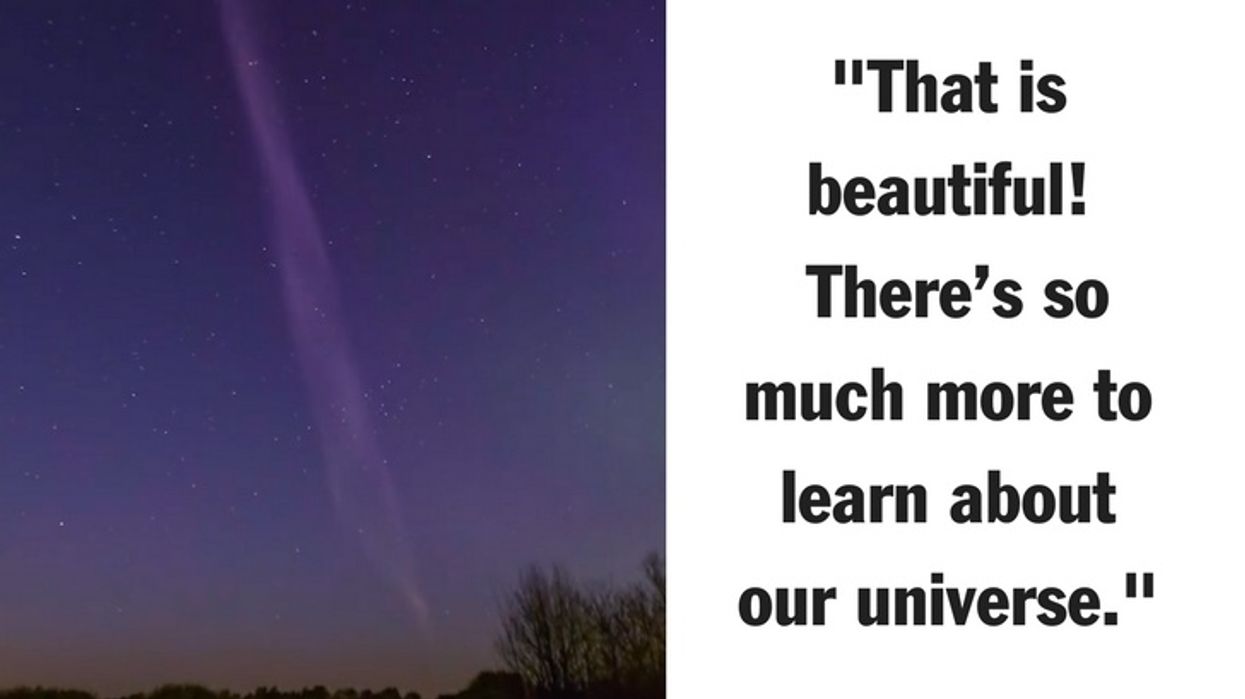

Locals in Regina, Canada, witnessed several sightings of a beautiful yet unfamiliar type of aurora borealis dancing above them between 2015 and 2016.
The friendly debate between scientists and admirers over its identity came to a resolve that was published in Science Advances, a peer-reviewed paper.
Introducing: Steve, the aurora.
The appearance of Steve is characterized by its glowing lavender and emerald ribbon stretching across the night sky from east to west. The undocumented phenomena was described in Science Advances:
This narrow, subauroral, visible structure, distinct from the traditional auroral oval, was largely undocumented in the scientific literature and little was known about its formation. Amateur photo sequences showed colors distinctly different from common types of aurora and occasionally indicated magnetic field–aligned substructures.
Observations from the Swarm satellite as it crossed the arc have revealed an unusual level of electron temperature enhancement and density depletion, along with a strong westward ion flow, indicating that a pronounced subauroral ion drift (SAID) is associated with this structure.
What's in a name? The moniker was given by enthusiasts and devoted amateurs who were the first to capture it on film.
On the basis of the measured ion properties and original citizen science name, we propose to identify this arc as a Strong Thermal Emission Velocity Enhancement (STEVE).
Steve differs from traditional auroras in many ways. It can be viewed closer to the equator than its more popular twin, and it emanates from a position twice the distance higher in the sky by roughly 125 miles.
Lawrence Lyons, a professor of physics at UCLA told Robinson Meyer of The Atlantic that a new aurora-related phenomenon has not been detected since the early 90s.
I've never seen something this new discovered by citizen scientists in the aurora before. Finding something you can identify as a new structure in the aurora is relatively unusual. The last major thing was poleward boundary intensification, and you can find that name used back over 20 years ago.
Steve is also a unique in that it was first documented by non-physicists.
An admirer of auroras noticed an unusual streak in the evening sky he mistook for an airplane contrail. But something about it was different. "It was clear the thing was emanating light, which contrails obviously don't do," said Chris Ratzlaff, who is a software developer by day.
After sharing his long-exposure photograph of the celestial streak with a Facebook group, he found others who've captured similar images of their own. He was told what he witnessed was a "proton arc," and it took two years for him to learn that wasn't the case.
The buzz generated from the unique images shared on social media groups helped scientists hone in on identifying the phenomenon.
Elizabeth MacDonald, a NASA physicist, launched the Aurorasaurus project which aimed to cultivate shared geo-tagged photos and videos of the aurora. It was an idea born out of a Twitter search during a major aurora storm in 2011.
I saw all these people tweeting about it, and I thought, we have to get these on a map. All of these citizen-science reports, in aggregate, can be compared to our models of aurora and ground-truth them, to give us a sense of how far south the aurora is extending.
MacDonald became active with the amateur enthusiasts through forum interactions and eventually made an appearance at a symposium at the University of Calgary.
Her Aurorasaurus passion project has become a success as well. In an email, she told The Atlantic, "We imagined learning more about the rare structures of aurora at mid-latitudes, but no, we never imagined finding something like Steve!"
Some saw a deeper meaning into the appellation of Steve. Could it be a subconscious homage to the late Stephen Hawking?
H/T - Twitter, Mashable, ScienceMag, YouTube,





 @dieworkwear/X






 @skylergisondo/Instagram
 @Pretefunkera/X
 @bonnieblue2025/X
 @Andie00471/X