Salad seeds that went on a round trip to outer space and back grew at a slightly slower rate than their Earth-bound counterparts, scientists have found.
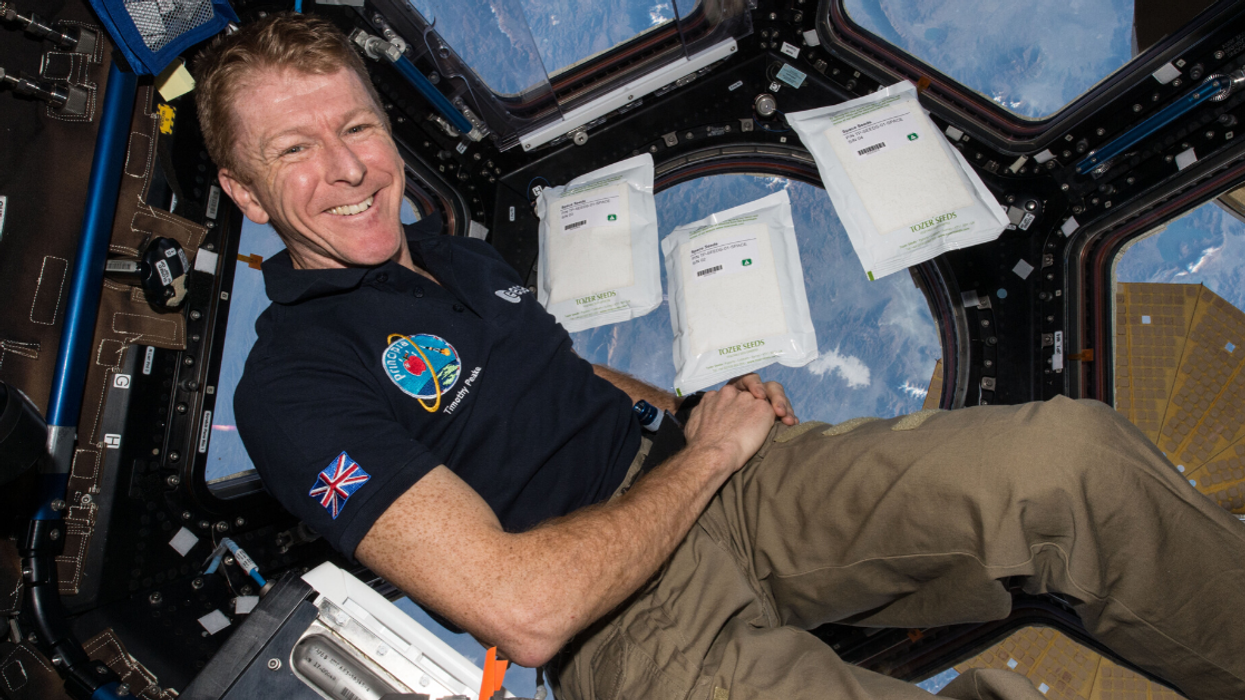
A million rocket seeds (Eruca sativa) amounting were sent to the International Space Station (ISS) in 2015 with British astronaut Tim Peake.
When they returned to Earth six months later, 600,000 children across the UK took part in an experiment organized by the Royal Horticultural Society to grow and monitor these seeds.
Although spaceflight did not compromise seed viability and development of the seedlings, the researchers said the “germination vigor" of the seeds was reduced. Yes, "germination vigor."
They believe their findings, published recently in the journal Life, take scientists a step closer to knowing whether edible crops can be cultivated on long space missions.
Dr. Jake Chandler works at the Royal Holloway's department of biological sciences in London and is the lead author on the paper.
“Transporting high quality seeds to space and beyond will be crucial for growing plants that support human exploration of space, Mars and other worlds," Dr. Chandler said.
“Our study found that a six month journey to space reduced the vigor of rocket seeds compared to those that stayed on Earth, indicating that spaceflight accelerated the aging process."
The researchers say that to maintain the quality of dormant seeds during spaceflights, they need to be protected from the harmful effects of cosmic radiation and mechanical vibrations of the spacecraft.
While aboard the ISS, the absorbed radiation dose of the seeds was found to be 100 times greater compared to the Earth's surface.
The researchers believe the radiation exposure during Mars missions would be at least five times greater than that of the ISS.
But despite these challenges, the experts say growing crops on long space missions could be achievable, if the seeds are sufficiently protected.
“Thus, while we should carefully consider protecting seeds from potentially harmful factors including space radiation and mechanical vibration, the seeds remained alive, and the prospect of eating home-grown salad on Mars may be one small step closer," Dr. Chandler said.
It was important that young people were involved in this experiment.
“In one of the largest and most inspirational experiments of its kind, more than half a million young people collected reliable data to help the scientists at Royal Holloway investigate the effects of spaceflight on rocket seeds," Major Peake added.
“When humans travel to Mars, they will need to find ways to feed themselves, and this research helps us understand some of the biology of seed storage and germination which will be vital for future space missions."





 @clare_baby05/Instagram
 @matteaing/Instagram
 @nowaythisismoney/Instagram
 @tifff847/Instagram
 @thisiserina/Instagram
 @empow51/Instagram
 @sruvaneslp/Instagram
 @amandaakay/Instagram
 @ashglowsup/Instagram
 @arielle.fears/Instagram
 @mindsetmatters_with_lila/Instagram
 @montanadragonfly79/Instagram