
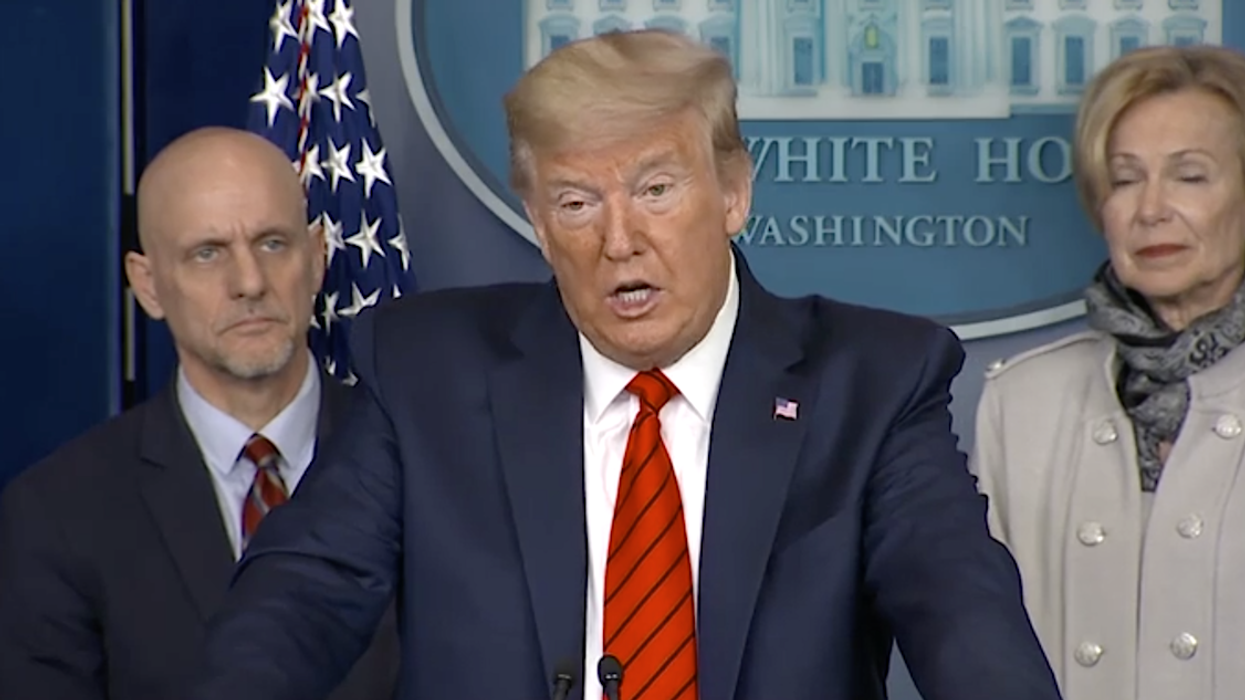

Leading up to the COVID-19 pandemic, the constant false claims and misinformation spread by President Donald Trump was troublesome to many.
But his comments now can legitimately prove deadly if someone follows his advice.
First Trump called the very real Novel Coronavirus danger a hoax and encouraged his followers to ignore warnings from the World Health Organization (WHO) and Centers for Disease Control (CDC). And on Thursday, the President told people in the United States that a drug introduced in 1944 was approved for treating COVID-19.
Trump said the drug—hydroxychloroquine or chloroquine—had shown promise at treating the COVID-19 disease.
You can see the President's remarks here.
Trump said:
"It is known as a malaria drug and it's been around for a long time and it's very powerful. But the nice part is it's been around for a long time so we know if things don't go as planned, it's not going to kill anybody."
The President added:
"Normally the FDA would take a long time to approve something like that, and it's—it was approved very, very quickly and it's now approved by prescription."
However reality is far from Trump's promising statement. Hydroxychloroquine is only in clinical trials to see if it will be effective against the coronavirus.
And the drug is quite capable of killing people despite the number of years it has been in existence.
Because of the dangers associated with telling the public a drug currently available is a proven treatment for COVID-19, Food and Drug Administration (FDA) commissioner Stephen Hahn contradicted the President almost as soon as Trump stopped talking by stating no drug had been approved to treat the coronavirus.
Hahn said:
"We may have the right drug, but it might not be in the appropriate dosage form right now, and it might do more harm than good."
French researchers—who announced their own initial results on Tuesday—echoed Hahn's statement. Their results stated that chloroquine is deadly if the dosage is wrong. No one should attempt to self treat with the drug until clinical trials are completed.
You can see more here:
Hahn added:
"The FDA's responsibility to the American people is to ensure that products are safe and effective, and we are continuing to do that."
Others, like Trump fact checker Daniel Dale of CNN, also tried to counter Trump's potentially deadly misinformation. Some people may already have access to hydroxychloroquine through a prescription for one of its approved uses.
If they try to self medicate against COVID-19, the results can prove fatal.
The FDA says:
- It's working with govt/academic entities already studying chloroquine for coronavirus
- It will continue to grant emergency compassionate use requests for another drug Trump mentioned, remdesivir, "but controlled clinical trials are needed" to test safety 2/
— Daniel Dale (@ddale8) March 19, 2020
- Hahn:: If chloroquine works for coronavirus, demand will increase; they'll "take all steps" to keep it available to "patients who take it to treat severe and life-threatening illnesses such as lupus." They want makers to ramp up production to mitigate any supply pressures 3/
— Daniel Dale (@ddale8) March 19, 2020
Hahn: This situation is urgent, but “we also must ensure these products are effective; otherwise we risk treating patients with a product that might not work when they could have pursued other, more appropriate, treatments." 4/4
— Daniel Dale (@ddale8) March 19, 2020
One more thing: as Trump said, chloroquine is approved for other uses like malaria. So doctors can legally prescribe it for unapproved coronavirus use if they want - contrary to Trump's claim, nothing was sped up to make it available. And it's not "approved" for coronavirus.
— Daniel Dale (@ddale8) March 19, 2020
You can already see the right wing troll spread of this false info. They're all over saying it's approved and works.
and they don't listen to reason on it.
He does damage with these false statements
— Rich Swinton (@RicoSuaveJD) March 19, 2020
Several people already arguing with me that it's approved for malaria, therefore it's a go.
No. It is only approved for malaria. Not for COVID. Your doctor will NOT prescribe this to you for COVID.
You cannot mass-prescribe an untested drug for a different pathogen.
— Rich Swinton (@RicoSuaveJD) March 19, 2020
The President lied about FDA approval. He does this constantly about every step of the process when it has come to COVID.
It creates false hope for people and a false narrative that they are making more progress than they are.
They did it with tests, with masks, and now drugs.
— Rich Swinton (@RicoSuaveJD) March 19, 2020
As of Thursday evening, total COVID-19 cases globally topped 218,000. At noon, the CDC updated their numbers of known infected to 10,442 and total deaths to 150.
While everyone is anxious for a vaccine for prevention or effective treatment for those infected, jumping the gun or making false claims is not the way to help anyone.


 reply to @bobmackie/Instagram
 reply to @bobmackie/Instagram
 reply to @bobmackie/Instagram
 reply to @bobmackie/Instagram
 reply to @bobmackie/Instagram
 reply to @bobmackie/Instagram
 reply to @bobmackie/Instagram



 @realDonaldTrump/Truth Social


 @ColoradoNana6/X
 @nogg_the/X
 @imduckymex/X