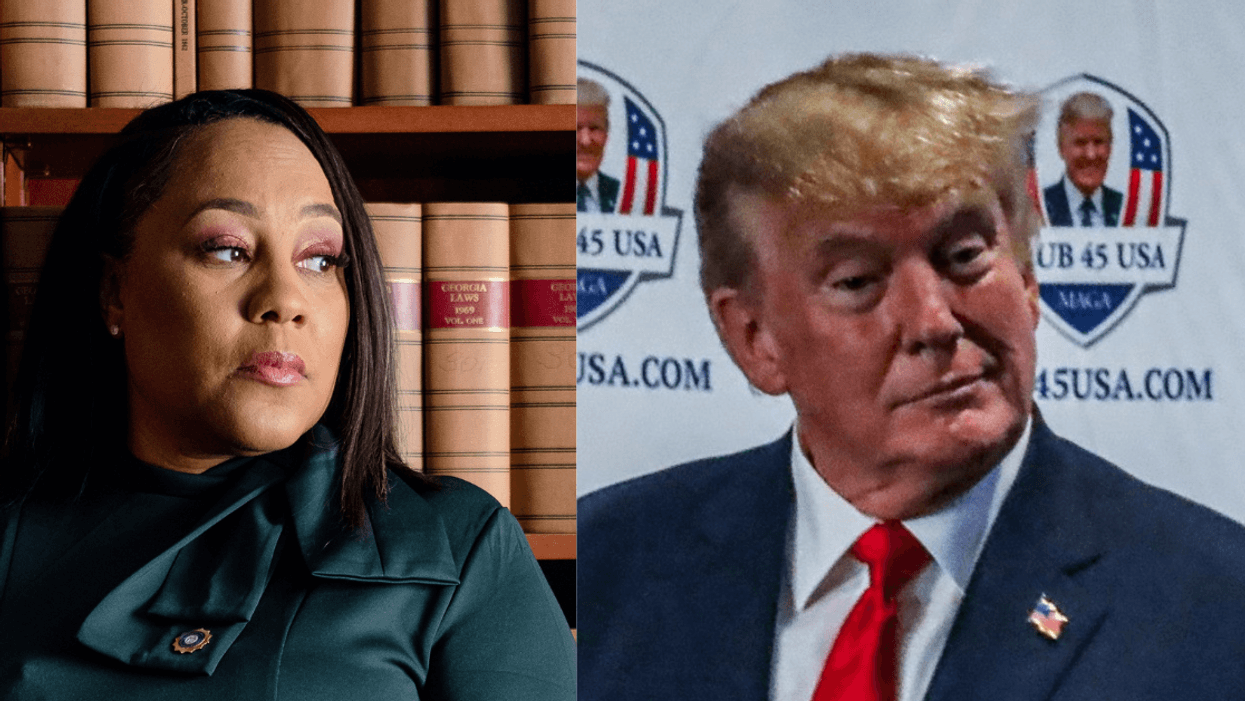

For some time, we have been watching the unfolding legal drama in Georgia, where recently a special grand jury completed its report and recommendations on indictments relating to charges of interference in the 2020 presidential election.
The grand jury forewoman gave a series of eyebrow raising interviews in which she made it clear there were multiple (i.e., more than 12) recommended indictments and we shouldn’t be “shocked” by whether the former President is (or is not) among them. She dropped this bombshell while providing some additional, specific details about witnesses, including that some were granted immunity to testify.
There’s a lot to unpack here, so let’s just dive right in by answering some of the most common questions folks have had.
What did she reveal exactly?
The forewoman gave several on-camera and in-person interviews to the press. She told the Atlanta Journal-Constitution in an interview that the grand jury had recommended multiple people be indicted.
She said:
“It’s not a short list."
Then rather coyly, she added:
“There may be parts of it that you did not expect, but I don’t believe the season finale will have any major plot twists, you know what I mean?”
She also revealed—beyond the infamous call made by Trump to Georgia Secretary of State Brad Raffensperger—there were other recordings of calls by Trump played before the grand jury but have yet to be made public.
She said:
“We heard a lot of recordings of Trump on the phone.”
When the reporter told her about Trump’s claim there was “total exoneration” from the grand jury, she rolled her eyes and burst out laughing.
She asked:
“Did he really say that?”
“Oh, that’s fantastic. That’s phenomenal. I love that.”
She refused to say if she had any further response.
The forewoman also went on NBC and CNN to speak to television audiences.
When asked about who was on the indictment recommendation list, she told NBC News:
“I don’t think there are any giant ‘that’s not the way I expected this to go at all’ moments.”
She added:
“I would not expect you to be shocked.”
Asked specifically whether the list included Trump, she said simply:
“Potentially. It might.”
To CNN, she stated she believed there were more than a dozen people on the list, and with respect to Trump, about whom she said they had heard a lot during the presentations, she was even bolder.
“But the big name that everyone keeps asking me about, I don’t think you will be shocked.”
This statement has elicited many opinions, from those who claim it suggests Trump will be on the list—because, after all, it would be shocking to indict so many people for a criminal conspiracy to interfere with the election and then not name the guy at the top—to those who claim it must mean Trump will not be on the list—because many people would be shocked to ever see an actual indictment of the former President.
These different reads, from the hopeful to the cynical, suggest that she has not actually revealed anything we can rely upon with respect to Trump himself as a possible defendant.
For the record, I am in the former camp. I believe he is on the list and that her statements very strongly suggest that.
Wait, but is she even allowed to say any of that?
Anyone familiar with grand juries, especially federal ones, knows they are usually shrouded in secrecy and the proceedings and deliberations are highly confidential, so much so that the mere existence of a grand jury often isn’t known until a lawyer for one of the witnesses or likely defendants goes to the press about it.
That’s why it was jarring to read an interview of the grand jury forewoman and then even more startling to see her appear on national television, casually and even flippantly discussing details of the proceedings.
Long time critics and opponents of Trump wrung their hands in dismay, thinking of all the ways this could derail the proceedings. Some legal commentators warned she might need an attorney for violating court orders around confidentiality.
But experts in Georgia law pointed out two things.
First, this was a special grand jury, which means it has the power to investigate and recommend indictments, but it does not have the power to issue those indictments. That must come from another grand jury that is separately empaneled.
Because the report of this grand jury is only ever advisory, the stakes are lower, at least in theory, and therefore any violations of confidentiality after the report has been issued do not really impact anyone’s rights because no one has been indicted yet.
Second, and more importantly, Georgia law treats special grand jury reports as presumptively public unless otherwise ordered. Generally, the only prohibition against jury members speaking to the press concerns their actual deliberations.
This was the admonition given by the court in this case: If you talk to the press, do not discuss jury deliberations, and keep the parts of the report that are confidential still confidential. Notably, the forewoman conducted her interview with the Atlanta Journal-Constitution with a notebook in hand containing instructions from the judge on what could and could not be discussed.
The more lax rules around confidentiality in Georgia are an outlier, but again, so is the idea of a special grand jury that simply investigates and doesn’t actually issue indictments. So far as I have seen, the forewoman has not discussed any actual grand jury deliberations and has not divulged any names on the indictment recommendation list, at least not yet.
Okay, but should she really be talking right now?
Whether you can say something and whether you should say something are of course entirely different matters.
In this case, it is not great optics for the District Attorney’s office to have the grand jury forewoman talking to the press at all while a decision on whether to indict is still pending, though it does add pressure on Fani Willis to act more quickly on those recommendations.
And it likely gives lawyers for the defendants a colorable basis to file a motion to dismiss the indictments due to juror misconduct. While that isn’t likely to work, it could cause further delay, which these days is the chief enemy of justice and accountability.
Her going public in this manner while also appearing rather unserious in press interviews also provides another narrative for right wing media to seize upon and leverage in favor of Trump.
I further would caution anyone against seeking even momentary notoriety in such a charged political environment.
You generally don’t want your name and face out there talking about possible recommended indictments against Trump when there are extremist followers of his who have a pattern of harassing and terrorizing people perceived to be part of a left-wing conspiracy out to get him, whether grounded in fact or not.
All that said, when and if indictments do come down from the regular grand jury, these recommendations and the forewoman’s behavior will likely be forgotten as Trump and his followers direct their ire at District Attorney Fani Willis.
After all, she holds the ultimate decision making authority and responsibility. In all likelihood, we will remember only that the jury forewoman gave us a pretty good heads up.
So what happens next?
If Willis follows the recommendations for indictments of multiple witnesses, she will need to make a presentation before a second grand jury. This will presumably be more streamlined as she will not have to call witnesses back in but can simply walk through the charges, the testimony and the evidence and then request that the second grand jury issue the indictments.
This is far more likely than a decision not to charge anyone; it is hard to imagine that Willis would just sit on the report and do nothing with it, given that she was the one who requested the special grand jury be empaneled and it now appears to have produced favorable recommendations on indictments.
The first thing the Trump lawyers will do, besides move to dismiss the indictments, will likely be to file a motion to remove the case to federal court.
One reason Trump may prefer a federal court is that the jury pool would pull from across all of northwestern Georgia, including many rural areas with many Trump supporters, whereas a state case would draw primarily from Fulton County, which is a Democratic stronghold.
Trump could argue that a transfer to federal court is appropriate because the case involves federal officers acting in their official capacities.
As University of Alabama law professor Joyce Vance discussed in her substack piece, whether Trump will succeed could turn on whether the courts believe that Trump and others were acting outside their authority when pressuring state officials to do things like “find” another 11,780 votes. (Narrator: Yes, indeed, they were.)
I raise this likely move to provide an example of how, even assuming indictments come down, there will be many more months where motions are heard, decided and appealed.
This could put any actual trial deep into 2024, which will make for an interesting political landscape to say the least, assuming Trump is among those indicted by the regular Georgia grand jury.
And this doesn’t even begin to factor in other criminal jeopardy Trump and his cohorts currently face from federal prosecutors.
A final thought, and a note to readers.
As things begin to really heat up around possible indictments, I sometimes see comments from folks who are understandably frustrated. “Wake me up when he’s in jail!” “If he was going to be arrested it would have happened by now!” “The system is too broken to ever hold him accountable!”
Let me first say, I get it.
There’s a collective exhaustion around these seemingly never-ending legal sagas. I also think it’s absurd that a man like Trump still walks around Mar-a-Lago a free man given his apparent crimes.
But accountability isn’t just about putting powerful people in jail for their crimes. It’s also about ensuring that a fair process is applied, and that the public understands the charges, the evidence, and the defenses so that true justice is not only achieved but welcomed by as many as possible.
When the likely defendant is an ex-President who still holds one of the major parties in his grip, it’s even more important that we remain vigilant and informed each step of the way, and not only when there is a big indictment, a guilty verdict, or even an actual prison sentence.
We citizens serve a vital function in the legal ecosystem of accountability. Our collective attention and interest motivates the press to continue to ask the tough questions and get the big scoops. That lets even the most powerful people know that they are being watched.
It reminds them that the system, which is supposed to serve us and not them, will do its best to hold criminals responsible for their actions. Yes, it is imperfect. Yes, it often fails.
But we must keep at this even if it takes longer than anyone wants, and even and indeed especially when those powerful, rich people deploy their enormous resources to try and thwart the very justice we seek.
The coming months will see many fits and starts attempting to hold Trump and his allies truly accountable. That is to be expected in these completely uncharted waters.
Through my writings here, I hope to provide clarity and explanations for why and how things happen, but I cannot provide the basic desire to see the process through. That must come from all of you.
It’s important not to turn cynical, particularly at this key juncture, and not to throw up our hands in despair or disgust. That is what they want us to do, and we should refuse to oblige them.
Instead, we can all help push the wheel forward, even if it sometimes rolls back upon us. To achieve this, we all have to put our shoulders to it, and not rely solely on the hard work of investigators and prosecutors.
We the public have a role to play in demanding justice and accountability. I will be here, with my flashlights out to shine on the path forward.
I hope we will walk it together, with our eyes on the prize, a steadfast determination in our gait, and a strong sense of justice and accountability in our hearts.
 mzshaysunshine/TikTok
 cerenjournals/TikTok
 Flick and Liv/TikTok
 isvbel.sb/TikTok
 Elisse Joy/TikTok
 WCTI News 12/YouTube
 reply to WCTI News 12/Facebook
 reply to WCTI News 12/Facebook
 reply to WCTI News 12/Facebook
 reply to WCTI News 12/Facebook