
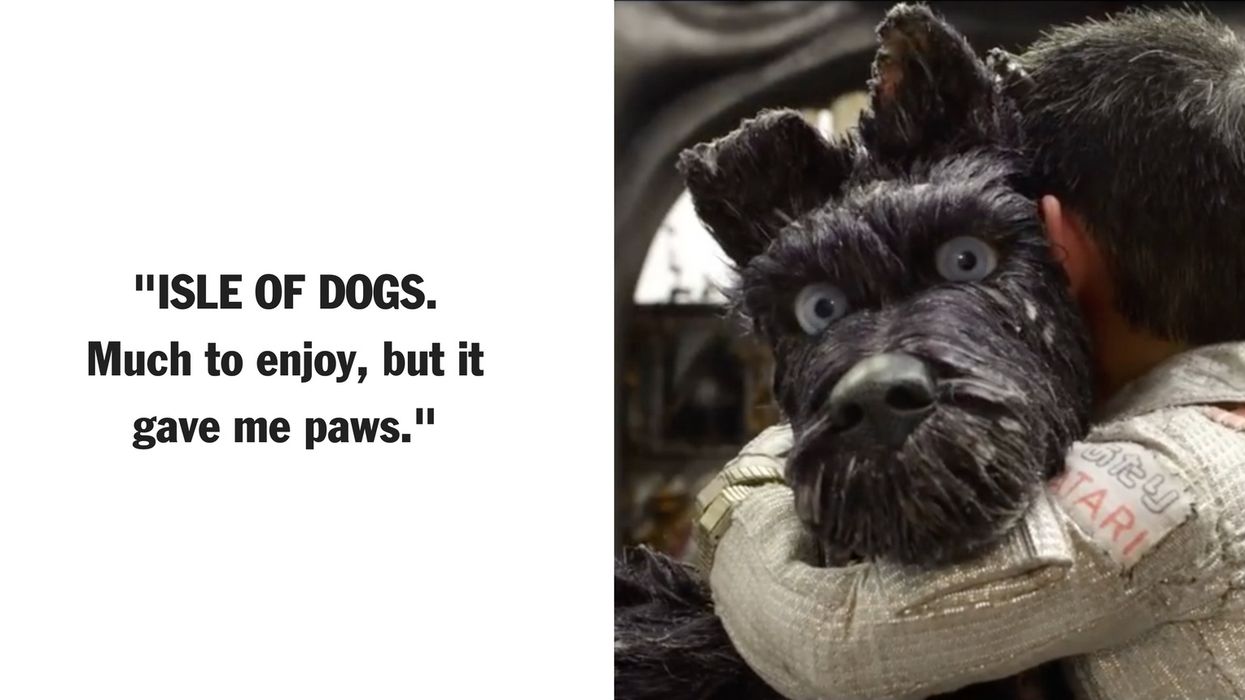

The new stop-motion animated film Isle of Dogs is under scrutiny for its alleged cultural appropriation.
Justin Chang of The Los Angeles Times described the movie, written and directed by Wes Anderson, as "often captivating, but cultural sensitivity gets lost in translation."
The film takes place 20-years into the future when by Executive Decree, all pet canines are exiled from the fictional city of Megasaki, Japan due to an outbreak of the dog flu. They are relocated to a garbage-infested wasteland where they fight for survival.
In describing the aesthetic rationale for the film, Chang said Anderson's vision comes up short.
If there is a reason to cherish this often captivating, sometimes irritating, unavoidably perplexing movie, it's that its mere existence seems to defy rational explanation. It is by turns savage and soulful, mangy and refined, possessed of an unmistakable pedigree and yet boldly resistant to categorization.
The Grand Budapest Hotel director won a directing award at the Berlin International Film Festival where Dogs screened its premiere. But the film was prematurely plagued with debates over its cultural appropriation.
Chang asked, "Does this white American filmmaker's highly selective, idiosyncratic rendering of an East Asian society constitute a sincere act of homage, or a clueless failure of sensitivity?"
While the critic was impressed by the film's more furry protagonists, he observed that "it's in the director's handling of the story's human factor that his sensitivity falters, and the weakness for racial stereotyping that has sometimes marred his work comes to the fore."
Anderson, a stickler for verisimilitude even in the weirdest situations, has the human residents of Megasaki City speak their native Japanese, a choice that would seem respectful enough except for the conspicuous absence of English subtitles.
Chang added:
Anderson, a stickler for verisimilitude even in the weirdest situations, has the human residents of Megasaki City speak their native Japanese, a choice that would seem respectful enough except for the conspicuous absence of English subtitles.
Although casting did include a handful of Japanese actors, they are billed towards the bottom of the extensive list in one of the trailers.
Vivian Kane for The Mary Sue called the movie "a whitewashing mess," and accused the actresses involved in Dogs – Scarlett Johansson and Tilda Swinton – for not learning their lessons "from being at the center of the debate over Hollywood's exclusion of people of color. That or they just don't care, I suppose."
"Wes Anderson is using Japanese aesthetics as pretty window dressing, and using Japanese people as background," Kane added.
By casting white actors in the lead roles over a Japanese backdrop, he's reinforcing the pervasive white-as-default mindset at the center of so much whitewashing. Whimsy and anthropomorphization don't change that.
Just because they're stop-motion dogs, that doesn't give Anderson a pass to put whiteness at the center of a story set in Japan.
Twitter users also had a bone to pick over the film's Japanese cultural representation, and they appreciated Chang for his pointed review.
A fellow LA Times writer tweeted, "Wes Anderson appropriates and marginalizes Japanese culture and people in his so-called homage. It is ugly, indeed."
Not everyone agreed with Chang's review of Dogs.
The post sparked a contentious debate when @grampaglasses reminded the critic that a Japanese writer was involved in the story development.
Kind of hypocritical to say a movie marginalizes a group of people when you don't even elaborate on such an obvious influence to the production like he is.
But Chang responded, "The presence of a key Japanese collaborator does not make Anderson any less the auteur of this or any of his films; nor does it exempt his work from scrutiny. As said in the review, I don't find tackling a different culture inherently problematic, and I enjoyed much of the movie."
Chang elaborated on his role as an entertainment critic and highlighted the issues he had with the film as part of his job.
The trailer alone made a bleak impact.
One user took issue with the egregious appellation of the 12-year-old boy who goes on a search for his body-guard dog, Spots.
The sharp review didn't undermine the entertaining credibility of the film, however.











 @JohnShoraka/X
 @gardengirl125/X


 @MeidasTouch/X
 @MeidasTouch/X